Skip to content

2026 How to Choose an Explosion Proof LED Floodlight?

Choosing an explosion-proof led floodlight is not just a matter of comparing wattage or price. The right fixture must suit the specific area, operating conditions, and lighting task. A unit that looks rugged may still be unsuitable if its certified protection markings do not match the site’s requirements. Check the product documentation carefully, and confirm that its certification applies to the intended location. When in doubt, consult a qualified safety or lighting professional.

Start with the work happening beneath the light. A loading bay may need broad, even coverage, while a tank inspection point may need a tighter beam. Consider mounting height, required brightness, glare, color temperature, and how easily workers can maintain the fixture. Dust, moisture, salt air, vibration, and temperature swings also affect long-term performance. Small details matter. A bright lamp can still leave deep shadows behind pipes or equipment.

Compare the housing, lens, seals, heat management, driver, and expected service life—not just the advertised lumen figure. Ask for test reports, installation guidance, warranty terms, and clear instructions for inspection and maintenance. Check whether the fixture’s operating temperature range fits the actual site, including hot days and enclosed spaces. Real installations can be less tidy than product photos suggest. Cable routing, brackets, and access for future servicing may become awkward after installation. This guide explains how to assess these factors, compare specifications, and choose an explosion-proof led floodlight with practical performance and dependable documentation. A careful review now can prevent costly mismatches later.
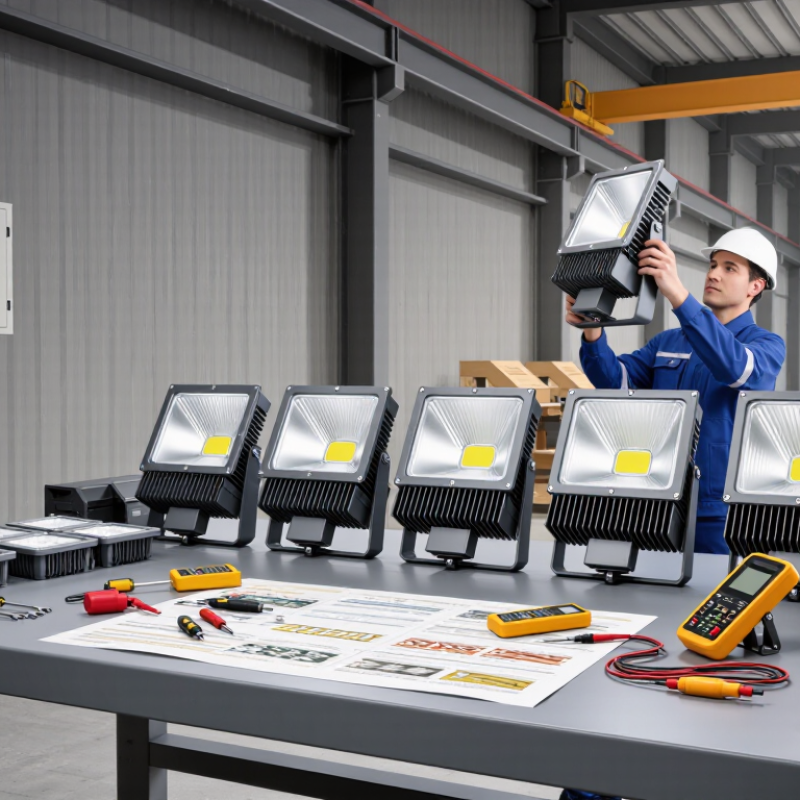
2026 How to Choose an Explosion Proof LED Floodlight?

What Is an Explosion-Proof LED Floodlight?

An explosion-proof LED floodlight is a light designed for hazardous locations where flammable gas, vapor, or combustible dust may be present. Its enclosure is built to contain an internal ignition and limit flame or hot gases escaping into the surrounding atmosphere. The fixture does not stop an explosion from happening. That distinction matters. In IEC terminology, related protection concepts include “flameproof” enclosures, addressed in the IEC 60079 series.

The enclosure, cable entries, seals, and lens all matter. A small scratch or mismatched fitting can undermine protection. Buyers should check the certification for the specific gas or dust group, temperature rating, and site classification, rather than relying on “explosion-proof” printed on a label. The U.S. Bureau of Labor Statistics recorded 106 fatal occupational injuries from fires and explosions in 2022, in its Census of Fatal Occupational Injuries. That figure covers many kinds of workplaces and does not measure lighting performance; it does underline why equipment selection and installation deserve care. Even a certified floodlight can be the wrong choice if its rating does not match the actual hazard or operating temperature. I would verify the marking against the site conditions, then have a qualified professional review the installation.

2026 How to Choose an Explosion-Proof LED Floodlight? – What Is an Explosion-Proof LED Floodlight?
Selection Dimension What to Check Practical Guidance
What it is A luminaire designed and certified for use in specified hazardous locations where flammable gas, vapor, mist, or combustible dust may be present. Its protection depends on the complete certified construction and installation—not on the LED light source alone. Follow the product certificate and installation instructions.
Hazardous-area classification The site’s applicable system and area classification, such as IEC/ATEX Zones or North American Class/Division or Zone designations. Confirm the exact location classification with the site’s hazardous-area documentation and the authority having jurisdiction. Do not assume that Zone and Division markings are interchangeable.
Gas or dust group The required gas/vapor or combustible-dust group stated in the equipment marking and certification. Verify that the marked group covers the substances present at the site. Gas and dust classifications use different group systems.
Temperature class and surface temperature The luminaire’s marked temperature class or maximum surface temperature, compared with the ignition requirements of the site’s substances. Select equipment whose permitted temperature is suitable for the identified hazard, including the expected ambient temperature and operating conditions.
Certification and marking Applicable approvals and the full equipment marking, such as ATEX or IECEx certification where required, or approvals applicable in the installation jurisdiction. Check the certificate, permitted area, gas or dust group, temperature limits, ambient range, and any special conditions of use. A general-purpose IP rating is not hazardous-area certification.
Ingress protection and environment The IP rating, corrosion resistance, resistance to water or dust exposure, and suitability for the site’s cleaning and weather conditions. Choose an enclosure suitable for the actual environment. IP protection addresses ingress under defined test conditions; it does not establish explosion protection.
Light output and efficacy Delivered lumens, lumens per watt, mounting height, task illuminance, and the effects of optics and enclosure design. Base the selection on a lighting layout or photometric calculation for the task area. Do not compare fixtures by wattage alone.
Beam distribution and glare Available beam patterns, aiming requirements, uniformity, spill light, and glare at the intended mounting position. Select optics for the application—for example, broad coverage for open areas or a more controlled distribution for specific work zones—and verify the result with photometric data.
Ambient temperature The certified operating ambient range, including local heat sources, weather, and enclosure conditions. Ensure the expected site temperature falls within the luminaire’s marked and certified range; output or service life may be affected outside specified conditions.
Electrical supply and controls Supply voltage and frequency, driver compatibility, inrush current, dimming method, and any required emergency-lighting arrangement. Confirm electrical ratings and permitted accessories against the equipment documentation. Use only controls and components suitable for the hazardous-area installation.
Construction and mounting Housing and lens materials, mounting orientation, bracket strength, cable entries, and compatibility with the site’s corrosion and vibration conditions. Check that cable glands, conduit entries, fasteners, and mounting accessories match the certified configuration and local installation requirements.
Maintenance and lifecycle Cleaning access, replaceable parts, driver and LED service information, warranty terms, and required inspection procedures. Plan inspection and maintenance in accordance with the manufacturer’s instructions and applicable regulations. Isolate power and follow site safety procedures before servicing.
Selection note: Final suitability depends on the hazardous-area classification, equipment certification, installation design, and applicable local requirements. Have the selection and installation reviewed by qualified personnel.

Which Hazardous-Area Rating Does the Site Require?

Choosing a floodlight starts with the site’s hazardous-area classification, not its brightness. Identify whether flammable gas, vapor, or combustible dust may be present, and how often. Gas areas may use Zone 0, 1, or 2 classifications; dust areas may use Zone 20, 21, or 22. The exact system depends on local requirements. Do not guess.

Check the fixture’s full marking against the site documents. The gas or dust group matters because different materials can ignite under different conditions. So does the temperature class: the light’s maximum surface temperature must remain below the ignition temperature of substances present. Also confirm the permitted ambient temperature range. A rating that fits the room but not a hot enclosure may be unsuitable.

IP ratings describe protection against dust and water; they do not, by themselves, confirm explosion protection. Dust matters too. Review the product’s certification, hazardous-area marking, and installation conditions with a qualified electrical or safety professional. If the classification is unclear, ask for the site assessment before ordering. A label can look reassuring and still be wrong for the location. This step is easy to overlook when a project is rushed.

How Should Light Output and Beam Angle Match the Task?

Match light output to the work plane, not the floodlight’s lumen rating alone. EN 12464-1:2021 gives common maintained-illuminance benchmarks of 300 lux for medium-precision assembly and 500 lux for fine assembly. These are reference points, not universal targets. Check the actual task, mounting height, surface reflectance, and maintenance conditions. A dusty lens or dark machine can reduce useful light. The IES Recommended Practice for Lighting Industrial Facilities, ANSI/IES RP-7-21, also emphasizes visual task needs, uniformity, and glare. More lumens do not automatically mean better visibility.

Beam angle determines where those lumens land. A narrower distribution can reach a distant inspection point in a tall bay, while a wider distribution may cover a low-ceiling work area with fewer dark gaps. For example, a 60-degree beam mounted high may leave shadowed edges; a 90-degree beam mounted low may create bright patches and glare. Check photometric data, such as an IES file, and compare predicted illuminance across the task area. In hazardous locations, confirm the fixture’s certified suitability for the specific area as well. This is easy to misjudge from a catalogue. A quick on-site measurement can reveal what the drawing missed.

Which Construction and Electrical Features Matter?

The housing is the first clue, not the whole answer. Look for a clearly marked hazardous-area rating that matches the site’s gas or dust conditions, temperature range, and ambient environment. A thick metal body may feel reassuring, but weight alone proves little. Check the certification documents and product markings together.

Inspect the enclosure joints, lens, and cable entries. A well-seated gasket helps keep dust and moisture away from internal components, while a protected lens can better withstand knocks and heat. Confirm that cable-entry threads and seals suit the installation. Small gaps matter. The mounting bracket should also hold the floodlight firmly where vibration or wind is expected.

Electrical details deserve equal care. Confirm the supply voltage and frequency, then check driver temperature limits, surge protection, and grounding provisions. Good thermal design helps control heat around LEDs and electronics, but actual performance depends on installation and operating conditions. Ask for test data when claims seem broad. I would not choose by wattage alone; a bright unit with poor heat management may age faster than expected. Have a qualified professional verify compatibility and follow the manufacturer’s installation instructions before energizing the fixture.

How Can You Verify Certification and Installation Suitability?

2026 How to Choose an Explosion Proof LED Floodlight?

How Can You Verify Certification and Installation Suitability?

Check the certificate, not just the product label. Confirm the exact model number, protection concept, gas or dust group, temperature class, and permitted ambient-temperature range. Compare these details with the hazardous-area classification for the actual installation point. IEC 60079 standards provide key requirements for equipment used in explosive atmospheres, while IECEx certification records can help verify certificate status and scope. A logo alone is not enough.

Then inspect installation details. Confirm the luminaire’s mounting method, cable-entry type, ingress protection rating, and operating temperature suit the site. Check that the installer follows the certificate’s conditions, including approved glands and earthing requirements. A floodlight rated for one area may not suit another. Small mismatches matter.

Tips: Ask for the certificate and instructions before purchase. Match every model suffix. Photograph the nameplate and cable entries during inspection. The U.S. Department of Energy’s 2019 Energy Savings Forecast of Solid-State Lighting report projected 569 TWh in annual lighting-energy savings by 2035 across general illumination. That figure is not specific to hazardous-area luminaires, and energy efficiency does not verify explosion protection. When a certificate’s scope is unclear, pause and ask a qualified hazardous-area specialist to confirm the fit.

“Guardian has been a tremendous help in providing storage and distribution solutions for AIR Global. We came to Guardian with a need, and they quickly found a solution for us at a very reasonable price. Our business is very demanding, especially during busy periods, and Guardian has been flexible and able to accommodate all requests with less than 48 hours’ notice. April, our main contact, has been extremely helpful in making sure our orders are shipped on time and that our inventory is accurate. I highly recommend using Guardian and look forward to continuing our relationship for many years to come.”

Matt Buffington
Director of Supply and Operations
Americas

“The Guardian Logistics Team is responsive and helpful on a consistent basis.  This removes a tremendous amount of stress and gives us incentive to route cargo that will touch your dock. Thanks for all that you do!!!”

Charles Reel
Branch Manager
Scan Global Logistics

“I recommend with great confidence, Guardian Logistics Solutions and owner, Brent Smith to whomever needs top shelf deliveries including Last Mile, White Glove, Residential and Commercial.

I have known GLS since its inception. Guardian is always looking for the right answer to solve the customer’s problem. I can, without hesitation, recommend Guardian Logistics to any company that is looking for the best service in their coverage area. They will team with you to create a solution that suits your needs and ensure you are satisfied with the outcome.”

Steven T. Nelson

“I highly recommend Guardian Logistics Solutions. The professionalism and communications offered by the team, along with speediness, cost saving solutions and attitude is a testament to the fact that this is one of the most important partners you can have in the freight movement business.

The company offers exemplary service, they continuously exceed our expectations and that of the importers, they help us service, Guardian Logistics Solutions is the best solid business partner you should add to your company.”

Ubaldo Sierra
Maersk Customs Brokers
General Manager

“Guardian Logistic Solutions is one of those rare companies who under-promise-and-over-deliver EVERY single time!”

James Burke
Manager, Sales Team
OLIMP Warehousing

“I want to thank the team at Guardian for the excellent service we have received.
The shipments have been professionally handled and freight arrives timely and in good order at a fair price. Communication is a very important part of the handling and Guardian does a great job of communication through the delivery.”

Cheri Zetrouer
Access Worldwide
Customs Brokers & Freight Forwarders

“I am very lucky to have found Guardian Logistics to help with our freight needs.  Our business is a bit unique in that we only receive a shipment every 2-3 months and we have to stick to a very strict time schedule in order to unload the delivery.  We found it virtually impossible to consistently coordinate with logistics companies to have shipments arrive on time and when they were expected. After multiple frustrating scenarios, our broker introduced us to Guardian Logistics who handled all of our shipments recently to perfection. Our shipments have arrived on time, when expected, with friendly and helpful drivers.  We will only be using Guardian moving forward for all of our shipping and freight needs. I couldn’t recommend them strongly enough!”

Trey Conrad
Owner
Patriot Power Source

“We have been working with the Guardian company for several years now and I can say without a doubt that their entire team cares about the service they provide. Their personal interest in their customers’ success makes them a standout in the world of final mile delivery.

I highly recommend Guardian for anyone requiring outstanding services in warehousing and final mile delivery programs.”

Frank Ianucilli
Director of Final Mile Operations
Werner Enterprises

“At WeFixFreight.com, client satisfaction is our main priority.  We are proud to partner with the top notch team at Guardian to bring our customers nothing but the best service when it comes to freight reworks, cross docking services, and final mile delivery.”

Bill Carlin
CEO
WeFixFreight.Com

“The Guardian Logistics staff has always been exceptional, and these days, with all the competition out there, it’s the service that matters. We appreciate all they do and look forward to continuing our business with GLS.”

Cathy Avolio
Ocean Import Manager
Mallory Alexander Int'l Logistics (NY), LLC
Back To Top