
Skip to content

10 Best 4x6 Thermal Labels for Shipping

A shipping label has one job: stay readable from packing table to delivery scan. Yet the wrong roll can waste time, peel at the corners, or print with faint barcodes. This guide compares 10 popular 4x6 Thermal Label options for everyday shipping, from small online shops to busy home workspaces. The right choice depends on more than price. Printer compatibility, adhesive strength, label count, and feed format all matter.

Look closely at the details. Some labels come on fanfold stacks, while others arrive on rolls that need a compatible holder. Direct thermal labels do not use ink or toner, but heat, sunlight, and storage conditions can affect how long printed text remains clear. A crisp barcode helps. So does a label that lies flat on a cardboard box instead of lifting during handling. Small details matter.

This roundup focuses on practical buying factors and clear trade-offs, not one universal winner. Check your printer’s supported label size and loading method before ordering; “4 x 6” alone does not guarantee a fit. Consider how many packages you ship, where labels will be stored, and whether easy peeling matters during a packing rush. One point can be easy to miss: the cheapest pack may not be the best value if labels jam or waste space. There is no perfect roll for every setup. Use the comparisons to narrow your options, then verify product specifications before buying.
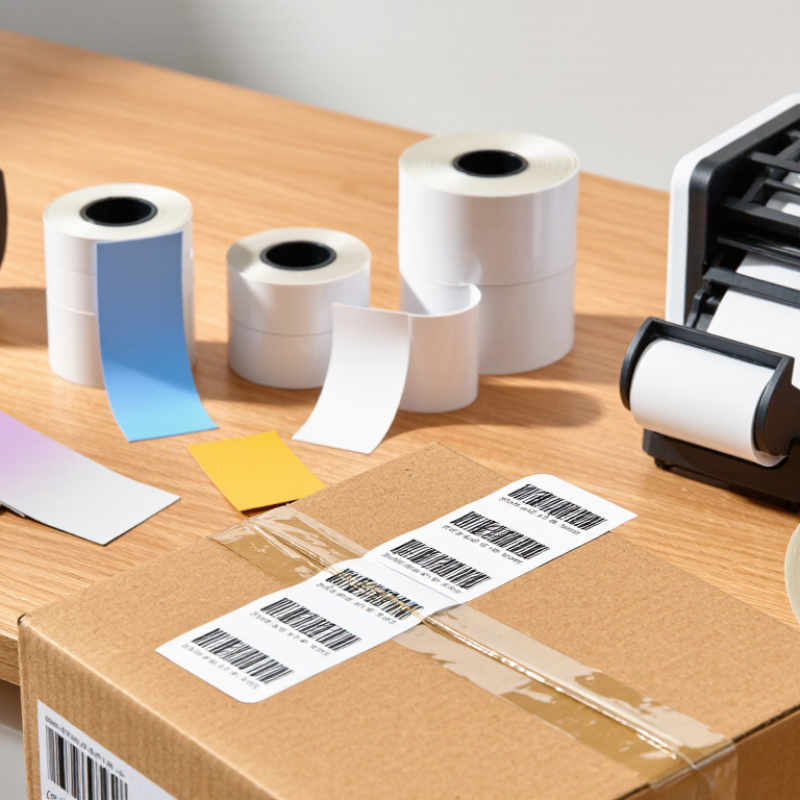
10 Best 4x6 Thermal Labels for Shipping

Understanding 4×6 Thermal Labels and How They Work

A 4×6 thermal label measures about 101.6 by 152.4 millimeters, giving a shipping address and barcode room to print clearly. In direct thermal printing, a heated printhead darkens a heat-sensitive coating on the label. No ink cartridge is needed. Thermal-transfer printers work differently, using a ribbon to transfer ink onto the label. The distinction matters: label stock must match the printer, or prints may smudge, fade, or fail to feed properly.

The 2023 Parcel Shipping Index reported an estimated 21.2 billion U.S. parcels in 2022, illustrating the scale of daily label handling. A label may pass through conveyors, sorting equipment, and delivery vehicles before it reaches a doorstep. Keep the barcode flat, sharp, and free of tape glare; test a sample before printing a full batch. Small setup errors add up. Printer settings also matter: select the correct label size, align the feed, and adjust darkness until fine barcode lines look distinct. Direct thermal labels can fade with prolonged heat or sunlight, so storage conditions deserve attention. One detail is easy to overlook: printer compatibility varies, even when labels share the same dimensions.

Key Factors for Evaluating Shipping Label Quality

A 4x6 thermal label must stay readable from the printer to the delivery route. Start with print consistency. Inspect a fresh label under bright light. Look for broken lines, pale patches, or fuzzy barcode edges. Small flaws matter. Dense black bars should remain distinct, with enough white space between them for reliable scanning. If text looks gray or uneven, check printer settings and label compatibility before changing supplies.

Adhesive performance matters just as much as print quality. Press a sample onto the actual carton, not a clean desk. Wait overnight. Check the corners for lifting, especially on textured or dusty cardboard. Surface conditions can change how well a label sticks. Also confirm the roll core, label gap, and feed direction match the printer; poor alignment can waste labels. One easy mistake is judging a label straight off the roll. A brief test in real packing conditions gives a more honest result, though it may not predict every damp or cold shipment.

10 Best 4×6 Thermal Labels for Shipping

The best 4×6 thermal labels for shipping are not one universal product. They include standard direct-thermal labels, top-coated labels for better resistance to scuffs, and permanent-adhesive labels for corrugated boxes. Removable adhesive can suit temporary packaging, while freezer-grade stock is designed for cold storage. Match the label to your thermal printer: roll and fanfold formats may load differently, and thermal-transfer printers require compatible ribbon. Small details matter.

Other useful options include perforated labels for easier separation, water-resistant stock for damp handling, high-tack adhesive for rough cartons, recycled-content labels, and labels with a larger gap between each print. These ten types serve different shipping needs; none is automatically best for every parcel. Check the core size, outside roll diameter, printer width, and sensor requirements before ordering. A label that fits the stated 4×6-inch size can still fail to feed smoothly.

For routine indoor shipping, standard direct-thermal stock is often a practical starting point. If parcels may sit in sunlight or face abrasion, compare coated options and test a small batch first. Print a sample, rub it gently, and press the adhesive onto the actual carton surface. I would not judge quality from a clean desk test alone. Cardboard dust, curved edges, and hurried packing can change how well a label sticks. One missed detail can mean a relabeling job.

How to Match Labels with Your Printer and Shipping Needs

10 Best 4x6 Thermal Labels for Shipping

A 4x6 label should match your printer before it matches your budget. Direct thermal printers use heat-sensitive labels; thermal-transfer printers generally need ribbon. Check the printer manual for supported label width, roll core, and loading method. Some models accept fanfold stacks, while others feed rolls more reliably. Fit matters.

Next, confirm how the printer detects each label. Many use a gap between labels; others rely on a black mark or continuous stock. Choosing the wrong sensing style can cause skipped labels or extra blank prints. For busy shipping days, test a short batch and scan a sample barcode. Keep labels flat and unwrinkled, with the barcode clear of seams and package edges. Adhesive strength also matters: a label that lifts from a textured carton may not travel well.

Tips: Print a few labels before buying a large pack. Compare actual dimensions, feed accuracy, and barcode readability. Store unused stock away from heat and direct sunlight, which can darken thermal paper. If labels print faintly, clean the printhead and check darkness settings before blaming the media. I’ve found that one test roll can reveal a mismatch, though printer settings sometimes need another adjustment.

Best Practices for Printing, Handling, and Storing Labels

A clean 4x6 thermal label starts with the right media setting. Match direct thermal labels to direct thermal mode, and thermal-transfer labels to the correct ribbon. A faint print can look acceptable on screen but fail under a handheld scanner. Keep the printhead clean, and check for missing lines before a busy shipping run. Small habits matter. ISO/IEC 15416:2016 grades linear barcode print quality on a 0.0-to-4.0 scale. That gives teams a measurable way to check legibility, rather than relying only on appearance.

Handle labels by the edges when possible. Oils, dust, and creases can weaken adhesion or interfere with scanning. Apply each label to a dry, smooth carton surface, away from seams and corners. Leave the barcode flat and unobstructed. After printing, scan a sample from the actual packing station; printer settings and carton textures can change results. A test sheet is useful, but it does not catch every real-world problem.

Store unused rolls in their original packaging, away from sunlight, heat, moisture, and dust. Follow the media supplier’s stated temperature and humidity limits, since coatings vary. Avoid placing heavy boxes on rolls; pressure can deform the edges. Rotate stock so older rolls are used first, and mark opened cartons with the date. It is easy to assume labels stay perfect on a shelf. They do not always. A quick print-and-scan check after storage can catch fading or feed issues before parcels pile up.

10 Best 4x6 Thermal Labels for Shipping – Best Practices for Printing, Handling, and Storing Labels

The options below are general label types rather than branded products. A 4 × 6 in label measures 101.6 × 152.4 mm. Check printer compatibility, carrier requirements, and the label supplier’s storage instructions before ordering.

Label type Construction Printer / ribbon Adhesive profile Best suited for Practical note
Standard direct-thermal paper Heat-sensitive paper; no ink or toner required Direct-thermal printer; no ribbon General-purpose permanent adhesive Routine parcel shipping and short-to-medium transit Keep away from excess heat, sunlight, and friction, which can darken or damage the printed surface.
Top-coated direct-thermal paper Direct-thermal paper with a protective top coating Direct-thermal printer; no ribbon General-purpose or application-specific permanent adhesive Shipments needing added resistance to handling or light moisture exposure A coating can improve surface durability, but does not make every label waterproof or suitable for outdoor exposure.
Permanent-adhesive direct-thermal paper Heat-sensitive paper with a permanent adhesive Direct-thermal printer; no ribbon Designed for a lasting bond on suitable, clean surfaces Corrugated cartons and common parcel packaging Press the label firmly onto a dry, smooth area; adhesion varies with surface, temperature, and application conditions.
Removable-adhesive direct-thermal paper Heat-sensitive paper with a removable adhesive formulation Direct-thermal printer; no ribbon Intended to peel away more easily than permanent adhesive Temporary identification or packaging where residue is a concern Not the default choice for shipping; confirm it will stay attached throughout the full delivery route.
High-tack direct-thermal paper Heat-sensitive paper paired with a higher-tack adhesive Direct-thermal printer; no ribbon Formulated for stronger initial tack on selected difficult surfaces Certain textured cartons or packaging that is harder to label Test on the actual packaging; “high-tack” performance is not guaranteed on dusty, oily, or very cold surfaces.
Cold-temperature adhesive direct-thermal paper Heat-sensitive paper with an adhesive designed for colder application or service conditions Direct-thermal printer; no ribbon Cold-rated adhesive; operating limits depend on the specific label Cold-chain parcels or labels applied to chilled packaging Check the supplier’s minimum application and service temperatures; they are not necessarily the same.
Synthetic direct-thermal film Heat-sensitive synthetic face stock rather than paper Compatible direct-thermal printer; no ribbon Adhesive varies by product and application Shipments where greater tear or moisture resistance is needed Verify print quality and printer compatibility; synthetic direct-thermal labels are not all equally durable.
Thermal-transfer paper Paper face stock printed by transferring ink from a ribbon Thermal-transfer printer; ribbon required Available with different adhesive options Shipping workflows needing a ribbon-based print system Match the ribbon type to the label material and printer; this is not a ribbon-free direct-thermal option.
Thermal-transfer synthetic film Synthetic face stock printed using a compatible thermal-transfer ribbon Thermal-transfer printer; ribbon required Choose adhesive for the intended surface and conditions More demanding handling or exposure than ordinary paper labels may tolerate A durable face stock alone does not guarantee chemical, weather, or abrasion resistance; validate the full label system.
Perforated fanfold direct-thermal labels Typically paper direct-thermal labels stacked in a continuous folded pack with perforations Compatible direct-thermal printer; no ribbon Usually supplied with a permanent adhesive; confirm specification Higher-volume printing or printers configured for fanfold media Confirm the printer accepts the pack, label gap, and feed path; fanfold describes the format, not a special print technology.

Printing, Handling, and Storage Best Practices

  • Confirm that the printer supports 4 × 6 in media and the label format (roll or fanfold); load direct-thermal labels without a ribbon and thermal-transfer labels with a compatible ribbon.
  • Use the printer’s media-sensing settings and a suitable print darkness and speed. Print a test label and check that barcodes are sharp, complete, and scannable.
  • Handle labels with clean, dry hands. Apply them to a clean, dry, smooth area, avoid seams and carton edges, and press down the full label surface.
  • Store unused labels in their original packaging in a cool, dry place, away from direct sunlight, heat, dust, and chemicals. Follow the label supplier’s stated temperature, humidity, and shelf-life guidance.
  • Keep direct-thermal labels away from heat sources and prolonged light exposure. Before large-scale use, test print quality and adhesion under the actual packing and transit conditions.

“Guardian has been a tremendous help in providing storage and distribution solutions for AIR Global. We came to Guardian with a need, and they quickly found a solution for us at a very reasonable price. Our business is very demanding, especially during busy periods, and Guardian has been flexible and able to accommodate all requests with less than 48 hours’ notice. April, our main contact, has been extremely helpful in making sure our orders are shipped on time and that our inventory is accurate. I highly recommend using Guardian and look forward to continuing our relationship for many years to come.”

Matt Buffington
Director of Supply and Operations
Americas

“The Guardian Logistics Team is responsive and helpful on a consistent basis.  This removes a tremendous amount of stress and gives us incentive to route cargo that will touch your dock. Thanks for all that you do!!!”

Charles Reel
Branch Manager
Scan Global Logistics

“I recommend with great confidence, Guardian Logistics Solutions and owner, Brent Smith to whomever needs top shelf deliveries including Last Mile, White Glove, Residential and Commercial.

I have known GLS since its inception. Guardian is always looking for the right answer to solve the customer’s problem. I can, without hesitation, recommend Guardian Logistics to any company that is looking for the best service in their coverage area. They will team with you to create a solution that suits your needs and ensure you are satisfied with the outcome.”

Steven T. Nelson

“I highly recommend Guardian Logistics Solutions. The professionalism and communications offered by the team, along with speediness, cost saving solutions and attitude is a testament to the fact that this is one of the most important partners you can have in the freight movement business.

The company offers exemplary service, they continuously exceed our expectations and that of the importers, they help us service, Guardian Logistics Solutions is the best solid business partner you should add to your company.”

Ubaldo Sierra
Maersk Customs Brokers
General Manager

“Guardian Logistic Solutions is one of those rare companies who under-promise-and-over-deliver EVERY single time!”

James Burke
Manager, Sales Team
OLIMP Warehousing

“I want to thank the team at Guardian for the excellent service we have received.
The shipments have been professionally handled and freight arrives timely and in good order at a fair price. Communication is a very important part of the handling and Guardian does a great job of communication through the delivery.”

Cheri Zetrouer
Access Worldwide
Customs Brokers & Freight Forwarders

“I am very lucky to have found Guardian Logistics to help with our freight needs.  Our business is a bit unique in that we only receive a shipment every 2-3 months and we have to stick to a very strict time schedule in order to unload the delivery.  We found it virtually impossible to consistently coordinate with logistics companies to have shipments arrive on time and when they were expected. After multiple frustrating scenarios, our broker introduced us to Guardian Logistics who handled all of our shipments recently to perfection. Our shipments have arrived on time, when expected, with friendly and helpful drivers.  We will only be using Guardian moving forward for all of our shipping and freight needs. I couldn’t recommend them strongly enough!”

Trey Conrad
Owner
Patriot Power Source

“We have been working with the Guardian company for several years now and I can say without a doubt that their entire team cares about the service they provide. Their personal interest in their customers’ success makes them a standout in the world of final mile delivery.

I highly recommend Guardian for anyone requiring outstanding services in warehousing and final mile delivery programs.”

Frank Ianucilli
Director of Final Mile Operations
Werner Enterprises

“At WeFixFreight.com, client satisfaction is our main priority.  We are proud to partner with the top notch team at Guardian to bring our customers nothing but the best service when it comes to freight reworks, cross docking services, and final mile delivery.”

Bill Carlin
CEO
WeFixFreight.Com

“The Guardian Logistics staff has always been exceptional, and these days, with all the competition out there, it’s the service that matters. We appreciate all they do and look forward to continuing our business with GLS.”

Cathy Avolio
Ocean Import Manager
Mallory Alexander Int'l Logistics (NY), LLC
Back To Top