Skip to content

10 Best Transport Trucks for Sale in 2026

Choosing a Transport Truck in 2026 means balancing payload, operating costs, uptime, and the routes your business actually runs. A tractor pulling long-haul freight faces different demands from a rigid truck making frequent urban deliveries. The stakes are substantial. The American Trucking Associations’ 2024 American Trucking Trends report says trucks carried 72.7% of U.S. domestic freight by weight in 2022. The International Energy Agency’s Global EV Outlook 2024 also reports that nearly 54,000 electric trucks were sold worldwide in 2023, reflecting a market that is changing, though unevenly.

This guide compares ten trucks through practical buying factors: configuration, payload capacity, fuel or energy options, driver comfort, safety technology, and service support. A day’s work can mean climbing a loaded highway grade, squeezing through a warehouse yard, or making repeated stops with a full body. Those details matter more than a polished brochure. We also consider the total cost of ownership, since purchase price alone cannot show what maintenance, fuel, charging, and downtime may add over time. No single ranking fits every fleet; available specifications and equipment can vary by market and model year. That limitation deserves attention. Use the comparisons as a starting point, then confirm current specifications, pricing, and warranty terms with the manufacturer or dealer before buying.
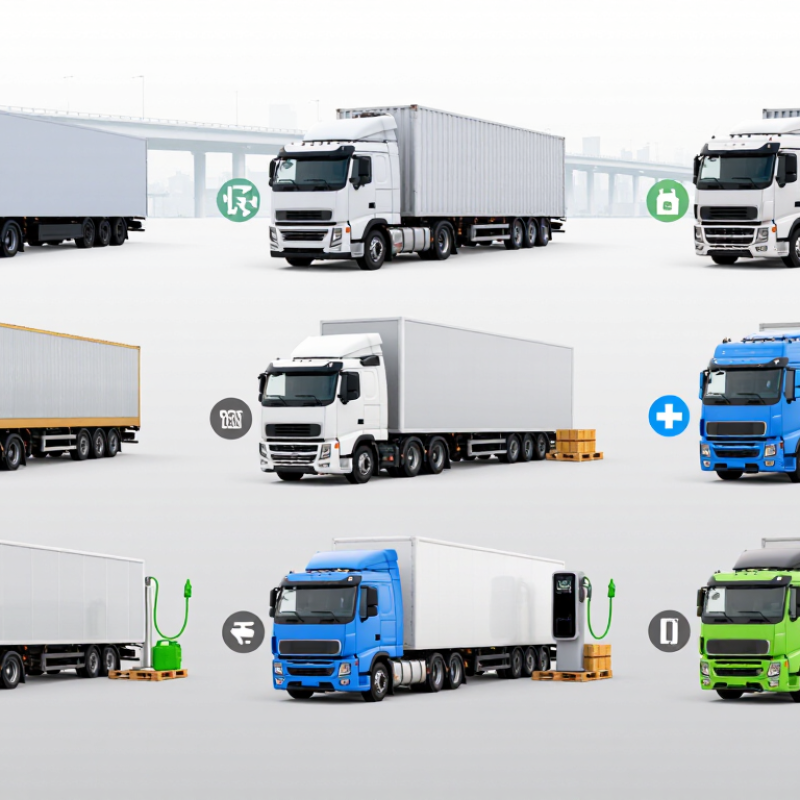
10 Best Transport Trucks for Sale in 2026

Transport Truck Categories: GVWR Classes 4–8 and Class 8’s 33,001-lb Threshold

Transport truck shopping often starts with GVWR, or gross vehicle weight rating. It is the vehicle’s maximum permitted loaded weight, including the truck, occupants, fuel, and cargo. It does not tell you how much cargo the truck can carry by itself.

In common U.S. classifications, Class 4 covers 14,001–16,000 lb; Class 5, 16,001–19,500 lb; and Class 6, 19,501–26,000 lb. Class 7 runs from 26,001 to 33,000 lb. Class 8 starts at 33,001 lb. That threshold matters, but a higher class does not automatically mean a better fit. Frame size, axle ratings, body equipment, and route conditions all affect real-world suitability. Class labels can make comparisons look simpler than they are.

Tips: Check the certification label and manufacturer’s specifications for the exact truck. Compare GVWR with expected loaded weight, then leave a practical margin. Measure loading-bay height and turning space, too. Small details matter.

A truck near a class boundary deserves extra attention. A heavier body or added equipment can reduce available payload, even when the GVWR stays unchanged. I would not choose by class alone; actual payload figures and the work cycle are more useful. Verify local requirements before purchase, since vehicle rules and definitions can vary by jurisdiction.

10 Best Transport Trucks for Sale in 2026 — Transport Truck Categories: GVWR Classes 4–8 and Class 8’s 33,001-lb Threshold

Transport Truck Type GVWR Class Class GVWR Range Typical Configuration Common Transport Work Key Buying Check
Light-duty box truck Class 4 14,001–16,000 lb Cab-and-chassis with an enclosed box body Local parcel, retail, and small-load delivery Check body weight, loading access, and remaining payload after the body and equipment are installed.
Medium-duty box truck Class 5 16,001–19,500 lb Enclosed box body, often with a liftgate option Regional deliveries and heavier palletized goods Confirm the liftgate’s rated capacity and account for its weight when calculating payload.
Urban delivery truck Class 5 16,001–19,500 lb Low-step or walk-through delivery body Frequent-stop routes in towns and urban areas Compare cab entry, door access, turning clearance, and route restrictions.
Flatbed work truck Class 6 19,501–26,000 lb Cab-and-chassis with a flat platform and tie-down points Building materials, machinery, and loads that are loaded from the side Verify deck dimensions, axle ratings, securement points, and the weight of any loading equipment.
Refrigerated box truck Class 6 19,501–26,000 lb Insulated box with a refrigeration unit Temperature-controlled food and other perishable goods Check the required temperature range, insulation condition, and refrigeration-unit service history.
Medium-duty dump truck Class 6 19,501–26,000 lb Dump body with a hydraulic hoist Construction, landscaping, and aggregate hauling Assess body condition, hoist operation, axle limits, and the material’s loaded weight.
Heavy-duty straight truck Class 7 26,001–33,000 lb Single-unit truck with a larger box, flatbed, or specialized body Regional freight and heavier local transport Review the truck’s actual axle ratings and body configuration; GVWR alone does not establish legal payload.
Class 7 refuse truck Class 7 26,001–33,000 lb Single-unit chassis with a refuse collection body Municipal and commercial waste collection Inspect the collection mechanism, hydraulic system, and maintenance records.
Class 8 tractor with semitrailer Class 8 33,001 lb and above Road tractor configured to pull a compatible semitrailer Long-distance and high-volume freight transport Match tractor, trailer, and route requirements; check applicable weight limits, ratings, and licensing rules.
Class 8 heavy vocational truck Class 8 33,001 lb and above Heavy chassis fitted with a dump, mixer, or other vocational body Heavy construction and specialized transport work Choose the chassis and body for the intended duty cycle, terrain, load, and equipment requirements.

Note: GVWR is the manufacturer-rated maximum loaded weight of a vehicle, including the vehicle, occupants, cargo, and equipment; it is not payload capacity. U.S. truck classes are based on GVWR. Class 8 begins at 33,001 lb. Actual specifications and legal operating requirements depend on the vehicle, configuration, and jurisdiction.

How to Compare 10 Trucks for 2026: Payload, GCWR, Horsepower, and Total Cost

10 Best Transport Trucks for Sale in 2026

Compare all ten trucks on the same job, not just on advertised horsepower. Check payload after adding the driver, tools, liftgate, and body equipment. A truck’s payload is its GVWR minus its actual curb weight; optional equipment can shrink the usable margin. Check GCWR against the loaded truck and trailer together. That matters. A higher rating is useful only if the vehicle can handle your usual route and load.

Horsepower affects acceleration on steep grades, but it cannot replace adequate payload or gearing. Use the same route and estimated load for each candidate. The Federal Highway Administration’s Freight Facts and Figures 2023 reports that trucks moved about 11.5 billion tons of U.S. freight in 2022. Freight needs vary widely, so that figure is context, not a buying rule.

For total cost, compare purchase price, financing, fuel, scheduled maintenance, tires, downtime, and expected resale value over your planned ownership period. The American Transportation Research Institute’s 2024 Operational Costs of Trucking report puts average 2023 operating costs at $2.27 per mile. It is an industry benchmark, not a prediction for any one truck. I would leave room for uncertainty: local fuel prices, repair access, and idle time can change the result. A simple spreadsheet may miss those details.

2026 Truck Profiles by Haul Type: Capacity, Drivetrain, and Key Specifications

Transport choice starts with the load, route, and loading space. The figures below are planning guides, not guaranteed payloads; body weight and configuration change usable capacity. For parcels, a light-duty van-based truck typically uses a 3.5–7.5-tonne gross vehicle weight and 4x2 drivetrain. An urban rigid truck often spans 7.5–18 tonnes, also in 4x2 form, with a low deck and tight turning radius. Regional distribution rigs commonly reach 18–26 tonnes and may use 6x2 axles for added capacity. Check the plate.

For temperature-controlled freight, a 12–26-tonne refrigerated rigid needs insulation, cooling equipment, and enough payload after both are fitted. Flatbeds in the 18–26-tonne range suit palletized or long materials; securement points matter as much as engine output. Construction tippers often use 6x4 drive and 18–32-tonne ratings for rough, uneven access. Refuse trucks generally need strong low-speed torque, frequent-stop durability, and 4x2, 6x2, or 6x4 layouts. Those bodies are heavy.

Long-distance tractor units usually pair a 4x2 or 6x4 chassis with a semitrailer; confirm the rated combination weight for the intended region and route. Heavy-haul work may call for 6x4 or 8x4 drive, reinforced frames, and auxiliary braking. Timber carriers also favor 6x4 or 8x4 layouts, with load space matched to log length. For bulk liquids, a dedicated tanker chassis needs compatible braking and axle ratings. I would not rank these by horsepower alone; it sounds tidy, but route gradients, idle time, and service access can overturn that choice.

Operating Costs and Compliance: Fuel Use and FMCSA’s 11-Hour Driving Limit within 14 Hours

Fuel use and driving-time compliance can change the real cost of a transport truck more than its purchase price suggests. When comparing trucks for 2026, estimate fuel consumption on the routes you actually run. A loaded truck climbing hills, idling at docks, or traveling in stop-and-go traffic may use far more fuel than a brochure figure implies. Small details matter. Tire condition, payload, speed, and maintenance all affect consumption. No estimate is perfect; route records will usually give a better starting point than a single advertised number.

For most property-carrying drivers covered by the federal hours-of-service rules, driving is limited to 11 hours after 10 consecutive hours off duty. Driving must also fall within a 14-hour window that begins when the driver starts work. That window does not pause for ordinary off-duty breaks. Plan delivery schedules around it, not just the truck’s range or cargo capacity. A late loading appointment can leave a driver short on legal driving time, even with fuel in the tank.

Ask how the truck’s expected route, payload, and daily mileage fit your operating plan. Review fuel receipts and electronic logging records together; they can reveal whether delays or excess idling are eroding efficiency. A truck that looks economical on paper may not be. Check current FMCSA guidance and qualified compliance advice when rules or operating conditions are unclear.

FAQS

What does GVWR mean?

GVWR is the maximum loaded weight of the truck, occupants, fuel, and cargo. It is not cargo capacity. That distinction matters.

When does a truck become Class 8?

Class 8 starts at 33,001 pounds GVWR. Class 7 covers 26,001–33,000 pounds. Check the truck’s certification label for its exact rating.

How can I estimate a truck’s usable payload?

Subtract the truck’s actual curb weight from its GVWR. Include the driver, tools, liftgate, and body equipment. I would double-check this calculation.

Is a higher truck class always a better choice?

No. Frame size, axle ratings, equipment, and route conditions affect suitability. A heavier body can reduce available payload. Small details matter.

What should I compare when choosing between trucks?

Compare each truck on the same route and estimated load. Check payload, GCWR, horsepower, gearing, and turning space. Horsepower alone can mislead.

Why should I check GCWR?

GCWR covers the loaded truck and trailer together. Compare it with their combined expected weight. That matters.

Which truck types suit different kinds of work?

Low-deck urban trucks can suit frequent city stops. Refrigerated trucks need insulation and cooling equipment. Construction tippers often need 6x4 drive for rough access.

What costs belong in a truck ownership estimate?

Include purchase price, financing, fuel, maintenance, tires, downtime, and resale value. Local repair access can change the total. A spreadsheet may miss things.

“Guardian has been a tremendous help in providing storage and distribution solutions for AIR Global. We came to Guardian with a need, and they quickly found a solution for us at a very reasonable price. Our business is very demanding, especially during busy periods, and Guardian has been flexible and able to accommodate all requests with less than 48 hours’ notice. April, our main contact, has been extremely helpful in making sure our orders are shipped on time and that our inventory is accurate. I highly recommend using Guardian and look forward to continuing our relationship for many years to come.”

Matt Buffington
Director of Supply and Operations
Americas

“The Guardian Logistics Team is responsive and helpful on a consistent basis.  This removes a tremendous amount of stress and gives us incentive to route cargo that will touch your dock. Thanks for all that you do!!!”

Charles Reel
Branch Manager
Scan Global Logistics

“I recommend with great confidence, Guardian Logistics Solutions and owner, Brent Smith to whomever needs top shelf deliveries including Last Mile, White Glove, Residential and Commercial.

I have known GLS since its inception. Guardian is always looking for the right answer to solve the customer’s problem. I can, without hesitation, recommend Guardian Logistics to any company that is looking for the best service in their coverage area. They will team with you to create a solution that suits your needs and ensure you are satisfied with the outcome.”

Steven T. Nelson

“I highly recommend Guardian Logistics Solutions. The professionalism and communications offered by the team, along with speediness, cost saving solutions and attitude is a testament to the fact that this is one of the most important partners you can have in the freight movement business.

The company offers exemplary service, they continuously exceed our expectations and that of the importers, they help us service, Guardian Logistics Solutions is the best solid business partner you should add to your company.”

Ubaldo Sierra
Maersk Customs Brokers
General Manager

“Guardian Logistic Solutions is one of those rare companies who under-promise-and-over-deliver EVERY single time!”

James Burke
Manager, Sales Team
OLIMP Warehousing

“I want to thank the team at Guardian for the excellent service we have received.
The shipments have been professionally handled and freight arrives timely and in good order at a fair price. Communication is a very important part of the handling and Guardian does a great job of communication through the delivery.”

Cheri Zetrouer
Access Worldwide
Customs Brokers & Freight Forwarders

“I am very lucky to have found Guardian Logistics to help with our freight needs.  Our business is a bit unique in that we only receive a shipment every 2-3 months and we have to stick to a very strict time schedule in order to unload the delivery.  We found it virtually impossible to consistently coordinate with logistics companies to have shipments arrive on time and when they were expected. After multiple frustrating scenarios, our broker introduced us to Guardian Logistics who handled all of our shipments recently to perfection. Our shipments have arrived on time, when expected, with friendly and helpful drivers.  We will only be using Guardian moving forward for all of our shipping and freight needs. I couldn’t recommend them strongly enough!”

Trey Conrad
Owner
Patriot Power Source

“We have been working with the Guardian company for several years now and I can say without a doubt that their entire team cares about the service they provide. Their personal interest in their customers’ success makes them a standout in the world of final mile delivery.

I highly recommend Guardian for anyone requiring outstanding services in warehousing and final mile delivery programs.”

Frank Ianucilli
Director of Final Mile Operations
Werner Enterprises

“At WeFixFreight.com, client satisfaction is our main priority.  We are proud to partner with the top notch team at Guardian to bring our customers nothing but the best service when it comes to freight reworks, cross docking services, and final mile delivery.”

Bill Carlin
CEO
WeFixFreight.Com

“The Guardian Logistics staff has always been exceptional, and these days, with all the competition out there, it’s the service that matters. We appreciate all they do and look forward to continuing our business with GLS.”

Cathy Avolio
Ocean Import Manager
Mallory Alexander Int'l Logistics (NY), LLC
Back To Top