
Skip to content

How to Choose the Right Fire Pump Hose?

Choosing the right Fire Pump Hose is a practical decision with serious safety consequences. A hose may look durable on a warehouse shelf, yet fail under heat, pressure, or repeated bending. The correct choice depends on pump capacity, operating pressure, diameter, coupling type, length, and intended environment. It must also match applicable fire-service standards and the manufacturer’s instructions.

Fire-service instructor Mark van der Feyst states, “Training is the key to success.” His point applies directly to hose selection. Experienced crews do not judge a hose by appearance alone. They inspect its pressure rating, jacket condition, fittings, flexibility, and storage history. A hose dragged across concrete may develop hidden damage. A coupling that fits poorly can waste valuable time.

Small details matter.

This guide examines how to compare Fire Pump Hose options with a safety-focused approach. It considers water flow, friction loss, heat exposure, chemical contact, maintenance needs, and compatibility with the pump system. These factors are easy to overlook during purchasing. They should not be.

No selection is perfect. Field conditions change, product data can be misunderstood, and even a high-quality hose needs regular inspection. That honest limitation matters. Buyers should verify technical specifications, request documented test information, and consult qualified fire-equipment professionals before making a final decision. A reliable hose is not simply strong. It is suitable, tested, correctly connected, and ready for the moment pressure rises.
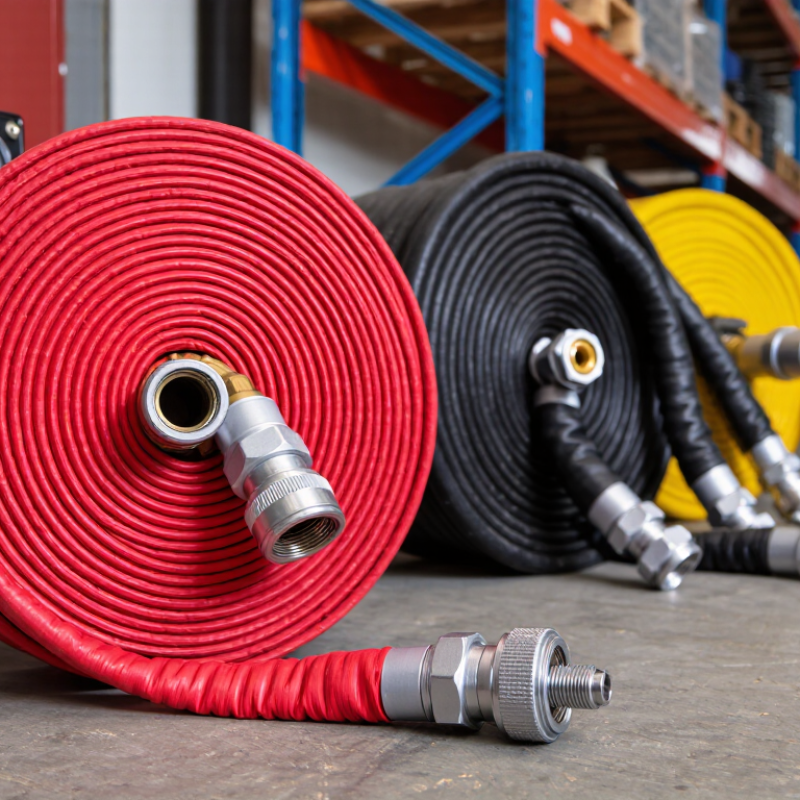
How to Choose the Right Fire Pump Hose?

Define pump duty with NFPA 20’s 150% flow and 65% pressure curve

Choosing a fire pump hose starts with the pump curve, not the hose label. NFPA 20, 2022 edition, requires a centrifugal fire pump to deliver rated flow at rated pressure. At 150% of rated flow, it must still produce at least 65% of rated pressure. That point matters.

A hose selected only for the rated duty point may suffer excessive friction loss during high-flow operation. Calculate flow, length, elevation, temperature, coupling losses, and working pressure together. Then compare the hose assembly with the pump’s 150% flow condition. Include suction conditions when selecting suction hose; collapse resistance and vacuum performance can be critical during startup. Do not guess.

NFPA’s Fire Loss in the United States During 2022 report estimated 1,504,500 fires and about 18.1 billion dollars in direct property damage. These figures show why dependable water delivery cannot rely on nominal sizing alone. Field inspections often find another weakness: a hose may meet pressure requirements but restrict flow through a small internal diameter or sharp bend. Small errors compound.

Use documented hydraulic calculations, manufacturer test certificates, and inspection records. The Hydraulic Institute also emphasizes evaluating rotodynamic pumps across their operating range, rather than at one isolated point. That principle applies to hose selection. A practical review should confirm the hose’s working pressure, burst margin, flow capacity, bend radius, coupling compatibility, and temperature rating. The 65% pressure requirement is not a target for comfort; it is a demanding checkpoint that exposes weak assumptions.

Select diameter using friction-loss data for 1½-, 2½-, and 3-in hoses

Choosing the right fire pump hose begins with friction-loss data, not diameter alone. A larger hose can move more water with less pressure loss, but it may be heavier and harder to position. A smaller hose is easier to handle, yet pressure can fall quickly at higher flow rates.

For 1½-inch hose, check the friction-loss chart at the intended flow and hose length. This size may suit shorter attack lines, but pressure loss can become significant as flow rises. A 2½-inch hose usually supports higher flow with lower resistance, making it useful for longer lines or larger water demands. A 3-inch hose can reduce friction loss further, especially on supply lines, although its weight and bending radius require more planning. Do not guess from diameter. Compare tested data at the actual flow rate.

Field conditions often change the calculation. Include elevation, couplings, valves, nozzle requirements, and the pump’s available pressure. I once treated hose diameter as the main answer. That was too simple. A chart may show acceptable loss, while a restrictive nozzle still creates a problem. Keep the manufacturer’s friction-loss table, pump curve, and inspection records together. Confirm the hose length on site, because an extra section adds resistance. Recheck calculations after changing flow, fittings, or elevation. Small assumptions can matter.

How to Choose the Right Fire Pump Hose? — Estimated Friction Loss by Hose Diameter
Flow Rate
(gpm)
1½-in Hose
(psi per 100 ft)
2½-in Hose
(psi per 100 ft)
3-in Hose
(psi per 100 ft)
1000.300.0250.010
1500.630.0520.021
2001.050.0870.036
2501.610.1330.055
3002.250.1860.076
4003.860.3190.131
5005.900.4880.200
6008.190.6770.278

How to use: Multiply the listed loss by the hose length in hundreds of feet. For example, 200 ft of 2½-in hose flowing 250 gpm has an estimated hose friction loss of 0.266 psi (0.133 × 2). Values are estimates calculated with the Hazen–Williams equation using a coefficient of 150 and the stated nominal diameters; actual loss varies with hose construction, condition, fittings, and internal diameter. Check current hose data and department pump charts before operational use.

Check working pressure against NFPA 1960 service-test requirements

How to Choose the Right Fire Pump Hose?

Check working pressure against NFPA 1960 service-test requirements.

A fire pump hose must handle the system’s real operating pressure, not only its maximum burst pressure. Compare the hose’s marked working pressure with the pump discharge pressure, including possible surges. The service-test pressure must meet the applicable NFPA 1960 requirement for that hose assembly. Requirements can vary by hose type, construction, and current standard edition.

Do not guess. Read the markings directly.

During selection, inspect the complete assembly. Check the hose, couplings, gaskets, and connected fittings together. A strong hose can still fail when an incompatible coupling leaks. Confirm that the assembly’s rated pressure exceeds the highest expected system pressure. Leave a practical safety margin, especially where pumps start abruptly or hydrant pressure changes quickly.

Field testing also matters. Use clean water, a calibrated pressure gauge, and a controlled test area. Follow the required test duration and inspection procedure for the applicable NFPA 1960 edition and local authority requirements. Look for seepage, bulging, damaged covers, coupling movement, or pressure loss. Replace or remove questionable hose from service. Records should show the test date, pressure, hose identification, and findings.

In real facilities, paperwork is often incomplete. That is a weakness worth correcting before an emergency. A hose selected from appearance alone may pass a visual check but fail under pressure. Verify every rating, document every test, and ask a qualified fire protection professional when the system conditions remain unclear.

Match couplings, linings, and nozzles with NFPA 1960 requirements

When selecting a fire pump hose, treat NFPA 1960 as a compatibility guide, not a shopping list. Confirm the edition adopted by your authority having jurisdiction (AHJ). Requirements can change.

Start with the pump outlet and hose coupling. Threads, size, gender, gasket design, and pressure rating must align. A coupling that fits by hand may still leak under operating pressure. That mistake is common.

The hose lining must suit the expected water quality, temperature, pressure, and storage conditions. A lining can appear smooth while hiding chemical or abrasion weaknesses. Select hose assemblies evaluated and tested under the applicable NFPA 1960 requirements.

Then match the nozzle to the hose diameter, flow demand, operating pressure, and coupling connection. A nozzle with the wrong flow profile can reduce pump performance or create excessive reaction force. Check shutoff operation and spray-pattern control under realistic pressure.

Field verification matters. Inspect actual threads, gasket seating, locking lugs, and coupling movement before installation. Do not assume two couplings are compatible because their diameters look similar.

Use documented pressure testing and inspection procedures required by the adopted standard, manufacturer, and AHJ. Keep records for each hose assembly. Labels help, but labels can be incomplete or damaged. Experienced crews still verify the hardware directly.

One detail is easy to miss: a nozzle may connect correctly yet fail to deliver the intended flow. Recheck the system after repairs, storage changes, or pump modifications.

Apply NFPA 1962’s annual fire-hose inspection and service-testing rule

How to Choose the Right Fire Pump Hose?

Apply NFPA 1962’s annual fire-hose inspection and service-testing rule

Choosing a fire pump hose starts with the pump’s rated flow and discharge pressure. The hose must also match the coupling, nozzle, storage method, and operating environment. A hose that looks strong may still fail under repeated bending, heat, abrasion, or chemical exposure. Field experience shows that tight cabinet storage often creates sharp folds near the coupling. That small detail deserves attention.

NFPA 1962 requires fire hose assemblies to receive inspection and service testing at least annually, with additional checks after use. Service testing should use controlled pressure, suitable equipment, and documented results. Inspectors should examine the jacket, lining, couplings, gaskets, and threads. Watch for cuts, soft spots, exposed reinforcement, and water leakage. The U.S. National Fire Protection Association reported 1,388,500 fires and about 22.2 billion dollars in property damage during 2023. Reliable hose maintenance supports a broader fire-protection program.

Keep records specific. Note the hose identification, test pressure, date, findings, and corrective action. Do not rely only on a passed pressure test. A coupling can operate poorly while the hose remains pressure-tight. That is where professional judgment matters. NFPA 1962 provides the framework, but site conditions determine the practical risk. Annual testing is essential, yet an annual visit should not replace routine visual checks by trained personnel. Some maintenance programs still treat paperwork as proof of readiness. That assumption needs review.

How to Choose the Right Fire Pump Hose?

Apply NFPA 1962’s Annual Fire-Hose Inspection and Service-Testing Rule

NFPA 1962 requires fire hose to be inspected after each use and at least annually. Fire hose must also receive a service test at least once every 12 months. Select hose materials, diameter, coupling type, and pressure rating that match the intended fire-pump application and the requirements adopted by the local authority having jurisdiction.

Chart metric: minimum interval between scheduled checks. Reference: NFPA 1962, Standard for the Care, Use, Inspection, Service Testing, and Replacement of Fire Hose.

“Guardian has been a tremendous help in providing storage and distribution solutions for AIR Global. We came to Guardian with a need, and they quickly found a solution for us at a very reasonable price. Our business is very demanding, especially during busy periods, and Guardian has been flexible and able to accommodate all requests with less than 48 hours’ notice. April, our main contact, has been extremely helpful in making sure our orders are shipped on time and that our inventory is accurate. I highly recommend using Guardian and look forward to continuing our relationship for many years to come.”

Matt Buffington
Director of Supply and Operations
Americas

“The Guardian Logistics Team is responsive and helpful on a consistent basis.  This removes a tremendous amount of stress and gives us incentive to route cargo that will touch your dock. Thanks for all that you do!!!”

Charles Reel
Branch Manager
Scan Global Logistics

“I recommend with great confidence, Guardian Logistics Solutions and owner, Brent Smith to whomever needs top shelf deliveries including Last Mile, White Glove, Residential and Commercial.

I have known GLS since its inception. Guardian is always looking for the right answer to solve the customer’s problem. I can, without hesitation, recommend Guardian Logistics to any company that is looking for the best service in their coverage area. They will team with you to create a solution that suits your needs and ensure you are satisfied with the outcome.”

Steven T. Nelson

“I highly recommend Guardian Logistics Solutions. The professionalism and communications offered by the team, along with speediness, cost saving solutions and attitude is a testament to the fact that this is one of the most important partners you can have in the freight movement business.

The company offers exemplary service, they continuously exceed our expectations and that of the importers, they help us service, Guardian Logistics Solutions is the best solid business partner you should add to your company.”

Ubaldo Sierra
Maersk Customs Brokers
General Manager

“Guardian Logistic Solutions is one of those rare companies who under-promise-and-over-deliver EVERY single time!”

James Burke
Manager, Sales Team
OLIMP Warehousing

“I want to thank the team at Guardian for the excellent service we have received.
The shipments have been professionally handled and freight arrives timely and in good order at a fair price. Communication is a very important part of the handling and Guardian does a great job of communication through the delivery.”

Cheri Zetrouer
Access Worldwide
Customs Brokers & Freight Forwarders

“I am very lucky to have found Guardian Logistics to help with our freight needs.  Our business is a bit unique in that we only receive a shipment every 2-3 months and we have to stick to a very strict time schedule in order to unload the delivery.  We found it virtually impossible to consistently coordinate with logistics companies to have shipments arrive on time and when they were expected. After multiple frustrating scenarios, our broker introduced us to Guardian Logistics who handled all of our shipments recently to perfection. Our shipments have arrived on time, when expected, with friendly and helpful drivers.  We will only be using Guardian moving forward for all of our shipping and freight needs. I couldn’t recommend them strongly enough!”

Trey Conrad
Owner
Patriot Power Source

“We have been working with the Guardian company for several years now and I can say without a doubt that their entire team cares about the service they provide. Their personal interest in their customers’ success makes them a standout in the world of final mile delivery.

I highly recommend Guardian for anyone requiring outstanding services in warehousing and final mile delivery programs.”

Frank Ianucilli
Director of Final Mile Operations
Werner Enterprises

“At WeFixFreight.com, client satisfaction is our main priority.  We are proud to partner with the top notch team at Guardian to bring our customers nothing but the best service when it comes to freight reworks, cross docking services, and final mile delivery.”

Bill Carlin
CEO
WeFixFreight.Com

“The Guardian Logistics staff has always been exceptional, and these days, with all the competition out there, it’s the service that matters. We appreciate all they do and look forward to continuing our business with GLS.”

Cathy Avolio
Ocean Import Manager
Mallory Alexander Int'l Logistics (NY), LLC
Back To Top