
Skip to content

How to Choose an Electric Cargo Bike for Business in 2026?

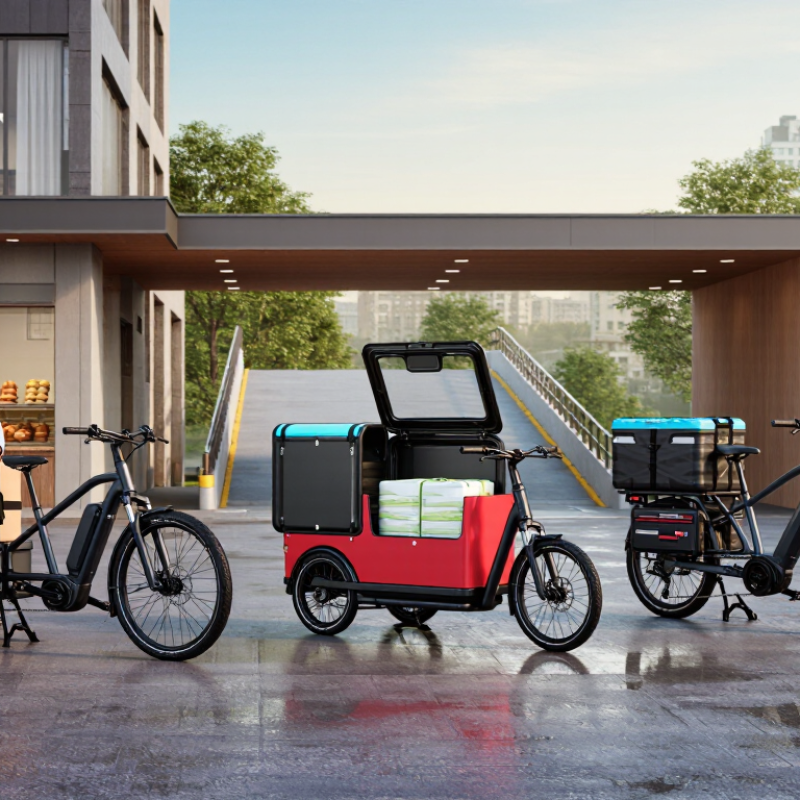
Choosing an electric cargo bike for business in 2026 requires more than comparing battery sizes or advertised range. The right model must match daily routes, payloads, storage needs, and rider habits. A bakery may need insulated boxes and stable low-speed handling. A repair company may value lockable compartments, climbing power, and weather protection. One bike cannot serve every operation.

Cycling and transport expert Chris Boardman has said, “The bicycle is the most efficient means of transport ever invented.” An electric cargo bike extends that efficiency when traffic, hills, and repeated deliveries make ordinary cycling difficult. However, efficiency depends on real conditions. A heavy load, frequent stops, cold weather, and steep streets can reduce practical range. Test those conditions before ordering a fleet.

Look closely at motor torque, battery capacity, charging time, braking performance, frame balance, and replacement-part access. A longtail may fit narrow lanes better, while a box bike can protect fragile goods more effectively. Measure doors, lifts, loading bays, and parking spaces. Also calculate total operating cost, including maintenance, insurance, staff training, and battery replacement.

The perfect specification may not exist. That is worth admitting.

A rushed purchase can create expensive downtime. A cautious trial can reveal awkward steering, slow loading, or uncomfortable seating before those issues affect customers. This guide will examine the practical decisions behind a reliable electric cargo bike purchase, helping businesses compare capability with cost, not marketing promises alone.
How to Choose an Electric Cargo Bike for Business in 2026?

Define Fleet Demand Using WEF’s 78% Urban Delivery Growth Forecast for 2030

The World Economic Forum has projected that urban last-mile delivery demand could grow by 78% by 2030. Treat that figure as a planning signal, not a promise about your own orders. Local demand varies. A bakery, pharmacy, and office-supply route have different loads, stops, and peak hours.

Start with delivery records from a typical week. Count parcels, miles, failed handoffs, and the time riders spend waiting at doors. Then model a busier day against the 2030 growth forecast. Do not simply add 78% more bikes. Better route density or larger cargo capacity may cover extra deliveries with fewer vehicles. Measure actual payloads, too: a box of meals is light, but bulky packages can fill a cargo bay quickly.

Choose a fleet that fits your streets and shifts. Check rated payload, real-world range with a full load, battery charging time, and whether riders can handle frequent stops safely. Test one route in rain and at the end of a long shift. Small details matter. A narrow loading entrance or steep ramp can erase the time savings. Keep some capacity in reserve, but avoid buying for a forecast alone. I would review the numbers quarterly; even careful estimates can miss seasonal peaks.

How to Choose an Electric Cargo Bike for Business in 2026?

Define fleet demand using the WEF’s forecast for urban delivery growth by 2030

The World Economic Forum forecast a 78% increase in urban last-mile delivery demand by 2030. The chart expresses that forecast as an index: reference level = 100, 2030 forecast = 178. Use local order volumes, route distances, payloads, and charging capacity to translate the growth outlook into fleet size.

Source: World Economic Forum, The Future of the Last-Mile Ecosystem (2020). The index values are derived from the reported growth forecast.

Set Payload and Volume Requirements Around EN 17860 Cargo-Bike Safety Standards

Before comparing electric cargo bikes, map the loads your business actually carries. Weigh the heaviest routine delivery, including the rider, tools, packaging, and accessories. Then measure the largest item, not just the average parcel. A tall box may fit by volume but raise the load’s centre of gravity. That matters on turns and rough pavement.

Use EN 17860 as a safety framework, not as a shortcut for choosing capacity. The series covers cargo-cycle design and testing; check which part applies to the vehicle type under consideration. Ask for documentation showing the tested configuration and stated maximum loads. Compare those figures with your real payload and cargo area, while allowing room for uneven loading and changing routes. A useful trial places weighted boxes where they will sit in service, then checks loading access, steering, braking, and stability. Keep heavy items low and secured. Small details count. A few centimetres can change handling. Do not assume that a larger cargo volume means a safer or more practical bike. Our estimates can be wrong, especially when seasonal loads vary, so record actual deliveries before settling on a specification.

Verify EU EPAC Compliance: 250 W Motor Power and 25 km/h Assist Cutoff

For a business cargo bike operating in the EU, check EPAC specifications before comparing payloads or battery ranges. The motor’s continuous rated power should not exceed 250 W, and assistance must cut out when the bike reaches 25 km/h. The motor may still turn, but it must stop providing assistance. A throttle that drives the bike without pedalling deserves closer scrutiny; don’t rely on a sales description alone.

Ask for the technical documentation and confirm that the figures refer to continuous rated power, not a brief peak output. Then inspect the bike’s display and test assistance on a safe, flat route. Watch the speed reading as you pedal past 25 km/h. Assistance should taper or stop; the transition can feel abrupt on some models. It’s a small detail, but loaded deliveries make it noticeable.

Check the exact configuration you intend to buy. A different controller or software setting may change how the bike behaves, and paperwork can be easy to overlook during a busy purchase. Keep the compliance documents with your fleet records, and verify that any later service or software update preserves the stated cutoff. I would not assume a familiar-looking label tells the whole story.

How to Choose an Electric Cargo Bike for Business in 2026? — Verify EU EPAC Compliance: 250 W Motor Power and 25 km/h Assist Cutoff

Check for Business Buyers What to Verify Why It Matters Evidence to Request
Continuous rated motor power For an EPAC within the relevant EU exclusion from type-approval requirements, the auxiliary electric motor’s maximum continuous rated power must not exceed 250 W. A higher rating may mean the vehicle does not qualify for the same EPAC treatment and may be subject to different approval and use requirements. Technical specification and manufacturer documentation stating the maximum continuous rated power. Do not rely only on a peak-power figure.
Assistance speed limit Motor assistance must progressively reduce and cut off when the bicycle reaches 25 km/h. Assistance above this threshold can change the vehicle’s regulatory classification. Written specification and a practical test confirming that assistance stops at the required speed.
Pedal-assistance operation The motor must provide assistance only while the rider is pedalling. Check any start-assistance or walk-assistance feature separately against applicable requirements. Motor operation independent of pedalling may affect whether the cycle meets the EPAC definition. Owner’s manual, operating description, and an in-person demonstration of the controls.
Regulatory documentation Confirm that the specific vehicle configuration is documented as an EPAC and that its technical details match the delivered model. Documentation helps establish what was supplied and supports fleet, insurance, and compliance checks. Declaration of conformity where applicable, product identification, technical file information, and user instructions.
Payload and cargo capacity Check the permitted gross vehicle mass and the separate load limits for the frame, cargo area, racks, and accessories. Limits vary by model and configuration; exceeding them can affect handling, braking, durability, and warranty coverage. Manufacturer’s load-limit documentation for the exact configuration, including rider, cargo, and accessory allowances.
Brakes and loaded stopping Assess braking performance with the intended business load, on the routes and surfaces where the bike will operate. Frequent stops, heavy loads, hills, and wet conditions place greater demands on brakes and components. Brake specifications, maintenance schedule, and a supervised test ride at a representative load.
Battery and daily range Compare usable battery capacity, charging arrangements, and expected range under the business’s actual load and route conditions. Range changes with cargo mass, terrain, temperature, riding style, and assistance level; a headline range is not a guaranteed delivery-route range. Battery capacity and charging information, plus a route trial or a range estimate based on the planned operating conditions.
Fleet uptime and service Check local service access, parts availability, warranty terms, and the recommended inspection schedule. Downtime can disrupt deliveries and increase operating costs. Written warranty conditions, service contacts, parts lead times, and a preventive-maintenance plan.
Business route suitability Test turning, parking, cargo access, visibility, and manoeuvrability on representative routes and at delivery locations. Cargo-bike dimensions and layouts affect access to cycle infrastructure, loading areas, and storage spaces. Dimensions and turning information, followed by a route-based test with a representative load.

Note: The 250 W continuous rated power and 25 km/h assistance cutoff are key EPAC criteria under EU rules. Confirm the current requirements and any national or local operating rules for the country where the business will use the vehicle.

Compare U.S. Class 1–3 Rules: 20–28 mph Assisted-Speed Limits

Choosing an electric cargo bike for business starts with its legal class, not its advertised range. In the United States, Class 1 models provide pedal assistance up to 20 mph. Class 2 models may use a throttle, but assistance generally stops at 20 mph. Class 3 models usually provide pedal assistance up to 28 mph. These definitions can change by state or city.

A 28 mph Class 3 bike may shorten delivery times on long routes. It can also require more attention to helmets, rider age, registration, or permitted paths. Some jurisdictions restrict Class 3 bikes from certain bike lanes. Local rules may also limit throttle use, even when the bike meets a broader national definition. Check the map. Then check the statute.

For a working fleet, test the bike with a full load, not an empty basket. Measure stopping distance near curbs, battery use on hills, and handling during repeated starts. A heavier cargo bike can feel stable at 20 mph but demanding at 28 mph. Class 1 may suit campuses and crowded neighborhoods. Class 2 can help riders who stop frequently. Class 3 may fit longer urban routes with safer road access. Do not assume faster means cheaper. Higher speeds can increase tire wear, charging needs, and training time. A spreadsheet will miss those details. The imperfect choice is often the one that matches local routes, rider skill, and actual delivery pressure.

Calculate Total Cost with 500–1,000 Battery-Cycle Life Benchmarks

For a business cargo bike, battery-cycle life changes the real cost of each delivery. A cycle means using the equivalent of a full battery charge; several partial charges can add up to one cycle. If a battery costs $900 and lasts 500–1,000 cycles, its battery cost is about $0.90–$1.80 per full cycle. Not a guarantee.

At 250 workdays and roughly one full cycle per day, that equals around $225–$450 in battery cost per year. Add the purchase price of the bike, charging electricity, routine service, and any replacement labor. Also consider downtime: a spare battery may cost more upfront but keep a route moving during a busy shift. Real routes vary. Heavy loads, hills, cold weather, and frequent fast charging can affect usable life, so treat the cycle range as a planning benchmark, not a promise.

Ask sellers how they define a cycle and what capacity remains at the stated limit. Compare that with your route: record daily distance, load, and battery use for a typical week. That estimate is tidy; actual delivery days rarely are. A spreadsheet can still expose whether a low purchase price hides higher battery costs over several years.

“Guardian has been a tremendous help in providing storage and distribution solutions for AIR Global. We came to Guardian with a need, and they quickly found a solution for us at a very reasonable price. Our business is very demanding, especially during busy periods, and Guardian has been flexible and able to accommodate all requests with less than 48 hours’ notice. April, our main contact, has been extremely helpful in making sure our orders are shipped on time and that our inventory is accurate. I highly recommend using Guardian and look forward to continuing our relationship for many years to come.”

Matt Buffington
Director of Supply and Operations
Americas

“The Guardian Logistics Team is responsive and helpful on a consistent basis.  This removes a tremendous amount of stress and gives us incentive to route cargo that will touch your dock. Thanks for all that you do!!!”

Charles Reel
Branch Manager
Scan Global Logistics

“I recommend with great confidence, Guardian Logistics Solutions and owner, Brent Smith to whomever needs top shelf deliveries including Last Mile, White Glove, Residential and Commercial.

I have known GLS since its inception. Guardian is always looking for the right answer to solve the customer’s problem. I can, without hesitation, recommend Guardian Logistics to any company that is looking for the best service in their coverage area. They will team with you to create a solution that suits your needs and ensure you are satisfied with the outcome.”

Steven T. Nelson

“I highly recommend Guardian Logistics Solutions. The professionalism and communications offered by the team, along with speediness, cost saving solutions and attitude is a testament to the fact that this is one of the most important partners you can have in the freight movement business.

The company offers exemplary service, they continuously exceed our expectations and that of the importers, they help us service, Guardian Logistics Solutions is the best solid business partner you should add to your company.”

Ubaldo Sierra
Maersk Customs Brokers
General Manager

“Guardian Logistic Solutions is one of those rare companies who under-promise-and-over-deliver EVERY single time!”

James Burke
Manager, Sales Team
OLIMP Warehousing

“I want to thank the team at Guardian for the excellent service we have received.
The shipments have been professionally handled and freight arrives timely and in good order at a fair price. Communication is a very important part of the handling and Guardian does a great job of communication through the delivery.”

Cheri Zetrouer
Access Worldwide
Customs Brokers & Freight Forwarders

“I am very lucky to have found Guardian Logistics to help with our freight needs.  Our business is a bit unique in that we only receive a shipment every 2-3 months and we have to stick to a very strict time schedule in order to unload the delivery.  We found it virtually impossible to consistently coordinate with logistics companies to have shipments arrive on time and when they were expected. After multiple frustrating scenarios, our broker introduced us to Guardian Logistics who handled all of our shipments recently to perfection. Our shipments have arrived on time, when expected, with friendly and helpful drivers.  We will only be using Guardian moving forward for all of our shipping and freight needs. I couldn’t recommend them strongly enough!”

Trey Conrad
Owner
Patriot Power Source

“We have been working with the Guardian company for several years now and I can say without a doubt that their entire team cares about the service they provide. Their personal interest in their customers’ success makes them a standout in the world of final mile delivery.

I highly recommend Guardian for anyone requiring outstanding services in warehousing and final mile delivery programs.”

Frank Ianucilli
Director of Final Mile Operations
Werner Enterprises

“At WeFixFreight.com, client satisfaction is our main priority.  We are proud to partner with the top notch team at Guardian to bring our customers nothing but the best service when it comes to freight reworks, cross docking services, and final mile delivery.”

Bill Carlin
CEO
WeFixFreight.Com

“The Guardian Logistics staff has always been exceptional, and these days, with all the competition out there, it’s the service that matters. We appreciate all they do and look forward to continuing our business with GLS.”

Cathy Avolio
Ocean Import Manager
Mallory Alexander Int'l Logistics (NY), LLC
Back To Top