Skip to content

How to Choose the Best Handheld Tyre Inflator in 2026?

Choosing the right Handheld Tyre Inflator in 2026 requires more than comparing pressure ratings and battery sizes. A compact device may look impressive on a product page, yet perform poorly beside a cold roadside tyre. Accuracy, inflation speed, heat control, connector design, battery endurance, and automatic shut-off deserve closer attention. Small details matter.

The U.S. National Highway Traffic Safety Administration recorded 738 deaths in tyre-related crashes during 2017. Its safety guidance repeatedly stresses correct tyre pressure. The U.S. Department of Energy also reports that underinflation can reduce fuel economy, sometimes by about 0.2% for every missing psi. These figures make a reliable gauge more important than a flashy display. AAA automotive expert John Nielsen has stated, “Proper tyre inflation is critical to safe vehicle operation.” His point remains practical, especially before long journeys, heavy loading, or sudden temperature changes.

This guide uses evidence from NHTSA, the Department of Energy, Consumer Reports testing principles, and current portable-inflator market research from IMARC Group. It also considers everyday experience: a dim screen at night, a stiff valve cap, or a compressor that overheats halfway through inflation. Those moments expose weak design quickly. They are easy to overlook.

The best model is not always the fastest or most expensive. A careful buyer should question advertised airflow, pressure accuracy, charging claims, and replacement-battery support. Some product specifications remain difficult to verify independently. That uncertainty matters. The following comparison helps identify a Handheld Tyre Inflator that is genuinely dependable, not merely convenient in a showroom.
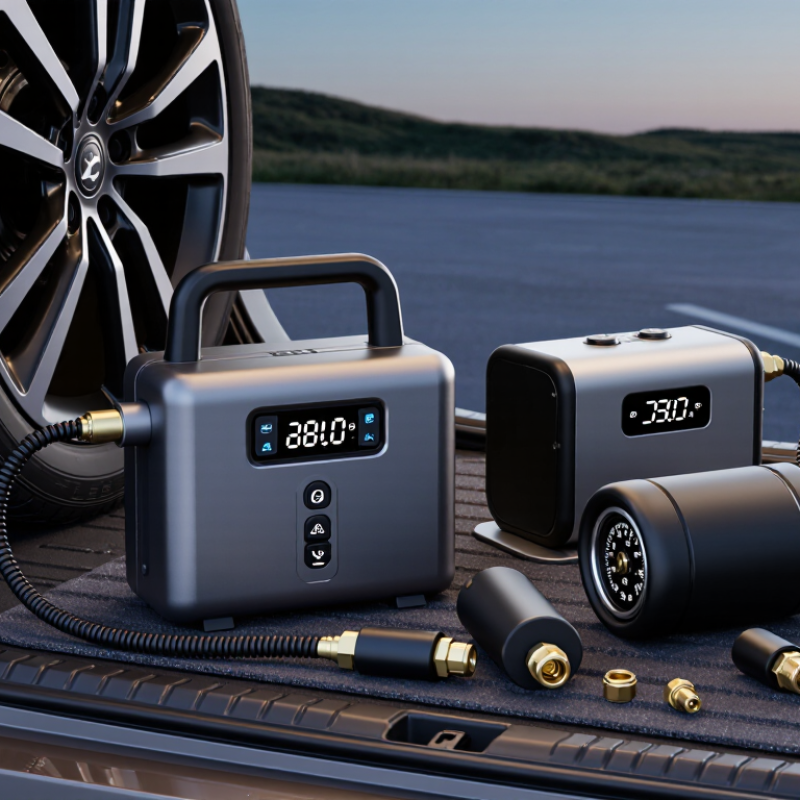
How to Choose the Best Handheld Tyre Inflator in 2026?

Define Required Pressure Using the Vehicle Placard and TPMS Guidance

How to Choose the Best Handheld Tyre Inflator in 2026?

The vehicle placard defines the required pressure, not the tyre sidewall. You usually find it inside the driver’s door frame or fuel flap. Check it before choosing a handheld inflator. The placard may list different pressures for front and rear tyres, especially under heavy loads. Always measure tyres when cold, ideally before driving. Heat increases pressure and can mislead your adjustment.

Your TPMS provides an important warning, but it is not a replacement for a gauge. It may alert you after pressure has already fallen significantly. The National Highway Traffic Safety Administration reported that TPMS technology can reduce severely underinflated tyres by about 55.6%. The U.S. Department of Energy also notes that underinflation can reduce fuel economy. Its guidance estimates a 1 psi loss may lower fuel economy by roughly 0.2%. Small errors matter. I once trusted a warning light alone, and the tyre felt noticeably soft before the system reacted.

Tips: Choose an inflator with a clear digital gauge, automatic shut-off, and a pressure range above your placard requirement. Compare its reading with a separate calibrated gauge. Keep the inflator charged in the vehicle, but do not store it loose near sharp tools. Check pressure monthly and before long trips. The best setting is the placard value, not the maximum number printed on the tyre.

How to Choose the Best Handheld Tyre Inflator in 2026? - Define Required Pressure Using the Vehicle Placard and TPMS Guidance

Pressure values shown as typical selection references only. Always follow the vehicle placard, owner’s manual, tyre instructions, and the inflator’s safety limits.
Selection Dimension Relevant Vehicle or Tyre Information Recommended Inflator Requirement Why It Matters Practical Check Before Purchase
Required cold pressure Many passenger vehicles use approximately 30–36 psi (207–248 kPa), but the correct value is the pressure printed on the vehicle placard. Choose an inflator that can reach at least 60 psi (414 kPa). It provides useful headroom for ordinary passenger-car and crossover applications without relying on the device at its maximum limit. Read the placard on the driver’s door frame, door edge, fuel flap, or inside the owner’s manual.
Higher-pressure applications Some light trucks, vans, trailers, and commercial vehicles require more than 50 psi (345 kPa), depending on axle load and tyre specification. Select a model rated for at least 100–150 psi (689–1,034 kPa) when these vehicles are involved. A higher maximum rating prevents the inflator from operating continuously at its limit. Confirm the placard pressure and the tyre’s permitted cold-pressure range before selecting the device.
Pressure-unit support Common units are psi, bar, and kPa. One bar equals approximately 14.5 psi; one psi equals approximately 6.895 kPa. Prefer a digital display with psi, bar, and kPa, plus simple unit switching. Correct unit selection reduces conversion errors and makes the reading easier to compare with the placard. Check whether the display remains readable in daylight and whether the selected unit is retained after restarting.
Preset and automatic shut-off The target should be based on the vehicle placard’s cold pressure, not the number molded on the tyre sidewall. Use a model with adjustable target pressure and automatic shut-off. Automatic shut-off helps reduce over-inflation when the target is entered correctly. Verify that the setting can be adjusted in small increments, preferably 0.5–1 psi or equivalent.
TPMS warning interpretation In the United States, the regulatory reference for many passenger vehicles is a warning when pressure is approximately 25% below the placard value. Actual vehicle behavior can vary. Choose an inflator with an accurate, readable pressure gauge; an accuracy claim of about ±1 psi is a useful benchmark. TPMS is a warning system, not a substitute for checking pressure with a gauge or inflator. Do not wait for the TPMS light. Check all tyres regularly, including the spare where applicable.
Cold-versus-warm measurement “Cold” means the vehicle has been parked for several hours and has not recently been driven or exposed to significant sunlight. Use the placard pressure as the cold reference and avoid correcting a warm reading by guesswork. Driving heats the air and can temporarily increase the pressure reading. Check and set pressures before driving, or after the tyres have cooled sufficiently.
Inflation speed A typical passenger-car tyre may require several minutes to inflate when substantially below its target pressure. For regular roadside use, look for an airflow rating around 20–35 L/min or higher, while treating manufacturer test conditions cautiously. Higher airflow can reduce waiting time, but real performance depends on tyre size, starting pressure, battery level, and hose length. Look for a published inflation-time test using a comparable tyre rather than relying only on maximum airflow.
Power source Portable inflators may use a rechargeable battery, a 12-volt vehicle socket, or both. For emergency use, dual-power operation is preferable; otherwise choose a battery with a stated voltage and capacity. A depleted battery can make a cordless inflator unusable when it is most needed. Check charging time, charging connector, cable length, and whether the device can operate while charging.
Duty cycle and cooling Compressors generate heat, especially when filling large tyres or several tyres consecutively. Prefer a clearly stated duty cycle, such as a maximum operating period followed by a cooling period. Following the duty cycle helps prevent thermal shutdown, premature wear, and heat-related damage. Do not select solely by maximum pressure; review the recommended continuous-use and cooling instructions.
Hose and cable reach Tyre valves may be difficult to reach on larger vehicles, trailers, or wheels with deep rims. Choose a hose of about 50–70 cm and a power cable of about 2.5–3.5 m for convenient roadside access. Greater reach reduces the need to reposition the vehicle or hold the inflator awkwardly. Check whether the hose connector locks securely and fits standard Schrader tyre valves.
Noise and vibration Small piston compressors commonly produce noticeable vibration and sound during operation. Prefer a model with a stable base, vibration-resistant feet, and a published noise figure when available. A stable design is easier to use at night and less likely to move while connected to the valve. Place the inflator on a firm, level surface and avoid operating it in enclosed spaces without ventilation.
Safety and visibility Roadside inflation may take place in low light, rain, or near moving traffic. Useful features include an integrated light, reflective elements, overheat protection, and a clear emergency procedure. Visibility and thermal protection improve usability, but they do not replace safe roadside positioning. Park in a safe location, activate hazard lights, and keep clear of traffic while inflating.
Tyre-pressure accuracy after adjustment Uneven pressure can affect handling, braking, rolling resistance, and tyre wear. Use the inflator’s gauge as a setting tool, then verify the result with a separate calibrated gauge when practical. Periodic verification helps identify gauge drift or differences between the inflator and the vehicle’s TPMS reading. Check pressure at least monthly and before long trips, always using the cold placard value as the reference.
Sidewall information The maximum pressure molded on a tyre sidewall is generally a tyre limit, not the vehicle’s recommended operating pressure. Select an inflator based on the vehicle’s required pressure and the tyre’s permitted limit. Using the sidewall maximum as the everyday target may produce an incorrect pressure for the vehicle. Never exceed the lower applicable limit among the vehicle, tyre, wheel, and inflator instructions.

Compare PSI, CFM, and Duty-Cycle Ratings with SAE Testing Data

How to Choose the Best Handheld Tyre Inflator in 2026?

PSI, CFM, and duty cycle reveal different parts of an inflator’s performance. PSI shows maximum pressure, not practical speed. A unit rated at 150 PSI may still inflate slowly at 35 PSI. CFM is more useful when measured at working pressure, rather than advertised as free-air flow. For a family car tyre, compare the time needed to raise pressure from 28 to 36 PSI. A stopwatch tells more than a large number. NHTSA research found that roughly one in four vehicles had at least one significantly underinflated tyre. The U.S. Department of Energy also estimates that each 1 PSI loss across tyres can reduce fuel economy by about 0.2%.

Duty cycle measures how long the compressor can run before cooling. A 10-minute rating may be adequate for one tyre, but uncomfortable for a four-wheel adjustment. SAE J1508 offers a useful reference for pressure-gauge accuracy, although it does not certify compressor speed. During testing, use a calibrated gauge, record ambient temperature, and repeat each inflation twice. My own mistake was trusting the digital display without checking heat buildup. The casing felt hot. Output had already slowed. SAE-style testing should record pressure, elapsed time, current draw, and recovery time, not PSI alone. Small details matter. A realistic test may expose disappointing results.

Evaluate Battery Capacity in Watt-Hours, Charging Time, and Runtime

How to Choose the Best Handheld Tyre Inflator in 2026?

Battery capacity deserves more attention than advertised pressure. Compare watt-hours, not only milliamp-hours. Watt-hours equal battery voltage multiplied by amp-hours. For example, a 14.8-volt, 2.0Ah battery stores about 29.6Wh. That figure allows fairer comparisons between different voltage systems. The U.S. Department of Energy notes that usable battery energy can differ from stated capacity because of conversion and charging losses. Therefore, treat the label as a ceiling, not a promise.

A practical inflator may draw roughly 100–150 watts while operating, depending on tyre pressure and motor load. A 30Wh battery could theoretically provide 12–18 minutes of continuous use. Real runtime is often shorter. Heat, cold weather, hose resistance, and automatic shut-off all reduce available energy.

I once found that a small car tyre consumed far more runtime than three bicycle tyres. That surprised me.

Charging time should match your routine. A 30Wh battery receiving 15 watts may need over two hours after losses. The Battery Council International reports that lithium-ion battery performance changes with temperature and charging conditions. Look for published charging times at room temperature, not vague “fast charging” claims.

Check whether the inflator supports charging during travel. Also inspect the charger’s output, battery protection, and replacement policy. A high-capacity battery is less useful if it takes overnight to recover.

My estimate may still be imperfect, because manufacturers rarely publish measured runtime under identical loads.

Check Accuracy Against the Industry Standard ±1 PSI Tolerance

How to Choose the Best Handheld Tyre Inflator in 2026?

Accuracy should guide your choice more than maximum pressure or display size. A practical industry benchmark is ±1 PSI. If your tyre requires 35 PSI, the inflator should show between 34 and 36 PSI. Small errors can affect handling, braking feel, and tread wear.

Test the inflator against a calibrated reference gauge. Check the tyre when it is cold, before driving several miles. Record the reading, add air, and measure again. Repeat this process three times. A reliable unit should produce consistent results, not one lucky reading. Watch the hose connection closely. Air loss there can create a false impression of poor accuracy.

My first comparison exposed an overlooked problem. One inflator matched the reference gauge, but its screen changed after the hose moved. That result was not useless, but it needed more checking. Temperature also affects readings, so a warm tyre may confuse your test. A clear display, automatic shut-off, and a stable chuck improve daily use. Still, verify the shut-off feature yourself. Do not assume the factory setting is perfect. A compact inflator becomes genuinely useful when its reading remains within ±1 PSI across repeated checks.

How to Choose the Best Handheld Tyre Inflator in 2026?

Compare the inflator reading with the target pressure. Under the industry accuracy criterion used here, the reading should remain within ±1 PSI of the target value.

Selection guide: A handheld tyre inflator should produce readings inside the shaded ±1 PSI tolerance range at the pressure required by your vehicle’s manufacturer placard. Consistent results across several pressure points are more important than a single accurate reading.

Verify Safety Through CE, UL, IP Ratings, and Thermal Protection

Choosing a handheld tyre inflator in 2026 means examining safety evidence, not merely maximum pressure. A bright display proves little. During practical checks, look for a clear CE mark, model number, manufacturer details, and instructions. The CE mark indicates conformity with applicable European requirements, but it is not a universal safety certificate. Request a Declaration of Conformity matching the exact model. Missing paperwork should slow the purchase.

UL is another useful signal, especially for electrical safety and fire resistance. However, “UL tested” may not equal certification. Check whether an independent listing applies to the complete inflator, its charger, or only one component. The file number and product identity should agree. Photographs of a logo are weak evidence. A readable label is better.

IP ratings describe resistance to dust and water, not impact or overheating. For roadside use, an IP54 enclosure offers limited dust protection and splash resistance. It should not sit in a puddle. Thermal protection matters when inflating several tyres. Look for automatic cut-off, temperature monitoring, blocked-air protection, and cooling intervals in the manual. Test the casing after one tyre; excessive heat is a warning. I would also question optimistic runtime claims, because cold weather and high-pressure tyres reduce performance. A cautious choice has traceable documents, realistic instructions, intact cables, and a verifiable warranty process.

“Guardian has been a tremendous help in providing storage and distribution solutions for AIR Global. We came to Guardian with a need, and they quickly found a solution for us at a very reasonable price. Our business is very demanding, especially during busy periods, and Guardian has been flexible and able to accommodate all requests with less than 48 hours’ notice. April, our main contact, has been extremely helpful in making sure our orders are shipped on time and that our inventory is accurate. I highly recommend using Guardian and look forward to continuing our relationship for many years to come.”

Matt Buffington
Director of Supply and Operations
Americas

“The Guardian Logistics Team is responsive and helpful on a consistent basis.  This removes a tremendous amount of stress and gives us incentive to route cargo that will touch your dock. Thanks for all that you do!!!”

Charles Reel
Branch Manager
Scan Global Logistics

“I recommend with great confidence, Guardian Logistics Solutions and owner, Brent Smith to whomever needs top shelf deliveries including Last Mile, White Glove, Residential and Commercial.

I have known GLS since its inception. Guardian is always looking for the right answer to solve the customer’s problem. I can, without hesitation, recommend Guardian Logistics to any company that is looking for the best service in their coverage area. They will team with you to create a solution that suits your needs and ensure you are satisfied with the outcome.”

Steven T. Nelson

“I highly recommend Guardian Logistics Solutions. The professionalism and communications offered by the team, along with speediness, cost saving solutions and attitude is a testament to the fact that this is one of the most important partners you can have in the freight movement business.

The company offers exemplary service, they continuously exceed our expectations and that of the importers, they help us service, Guardian Logistics Solutions is the best solid business partner you should add to your company.”

Ubaldo Sierra
Maersk Customs Brokers
General Manager

“Guardian Logistic Solutions is one of those rare companies who under-promise-and-over-deliver EVERY single time!”

James Burke
Manager, Sales Team
OLIMP Warehousing

“I want to thank the team at Guardian for the excellent service we have received.
The shipments have been professionally handled and freight arrives timely and in good order at a fair price. Communication is a very important part of the handling and Guardian does a great job of communication through the delivery.”

Cheri Zetrouer
Access Worldwide
Customs Brokers & Freight Forwarders

“I am very lucky to have found Guardian Logistics to help with our freight needs.  Our business is a bit unique in that we only receive a shipment every 2-3 months and we have to stick to a very strict time schedule in order to unload the delivery.  We found it virtually impossible to consistently coordinate with logistics companies to have shipments arrive on time and when they were expected. After multiple frustrating scenarios, our broker introduced us to Guardian Logistics who handled all of our shipments recently to perfection. Our shipments have arrived on time, when expected, with friendly and helpful drivers.  We will only be using Guardian moving forward for all of our shipping and freight needs. I couldn’t recommend them strongly enough!”

Trey Conrad
Owner
Patriot Power Source

“We have been working with the Guardian company for several years now and I can say without a doubt that their entire team cares about the service they provide. Their personal interest in their customers’ success makes them a standout in the world of final mile delivery.

I highly recommend Guardian for anyone requiring outstanding services in warehousing and final mile delivery programs.”

Frank Ianucilli
Director of Final Mile Operations
Werner Enterprises

“At WeFixFreight.com, client satisfaction is our main priority.  We are proud to partner with the top notch team at Guardian to bring our customers nothing but the best service when it comes to freight reworks, cross docking services, and final mile delivery.”

Bill Carlin
CEO
WeFixFreight.Com

“The Guardian Logistics staff has always been exceptional, and these days, with all the competition out there, it’s the service that matters. We appreciate all they do and look forward to continuing our business with GLS.”

Cathy Avolio
Ocean Import Manager
Mallory Alexander Int'l Logistics (NY), LLC
Back To Top