How to Choose the Best Sauce Cup Paper Supplier?
Choosing the right Sauce Cup Paper supplier involves more than comparing unit prices. The material must protect sauces from leaks, grease, moisture, and flavor transfer during filling, transport, and service. A weak paper cup may soften beside hot fries or leave oil marks on a delivery bag. Small failures can damage customer trust.
Industry data shows why supplier evaluation matters. Smithers’ The Future of Global Packaging to 2028 estimates that the global packaging market will approach $1.3 trillion by 2028. Its analysis also highlights sustainability, material efficiency, and regulatory pressure as major purchasing factors. Meanwhile, PMMI reports continued investment in food-packaging automation, where consistent dimensions and reliable sealing support efficient production. These trends affect even small condiment containers.
Walter Soroka, author of Fundamentals of Packaging Technology, defines packaging as “the science, art, and technology of enclosing and protecting products.” That principle fits Sauce Cup Paper closely. A capable supplier should provide food-contact documentation, coating details, migration-test evidence, and stable production quality. Ask for samples, not promises. Test them with oily sauces, refrigerated storage, stacking pressure, and realistic delivery times.
Cost still matters.
However, the cheapest quotation may hide excessive waste, inconsistent printing, or poor moisture resistance. Buyers should also examine recycled content, fiber sourcing, coating recyclability, minimum order quantities, and lead times. No supplier is perfect. Even a strong factory may struggle during peak seasons or material shortages. A careful comparison, supported by samples and documented performance, helps you choose a Sauce Cup Paper partner with confidence.
Define 2–4 oz Capacity, 250–350 gsm Board, and Barrier Requirements
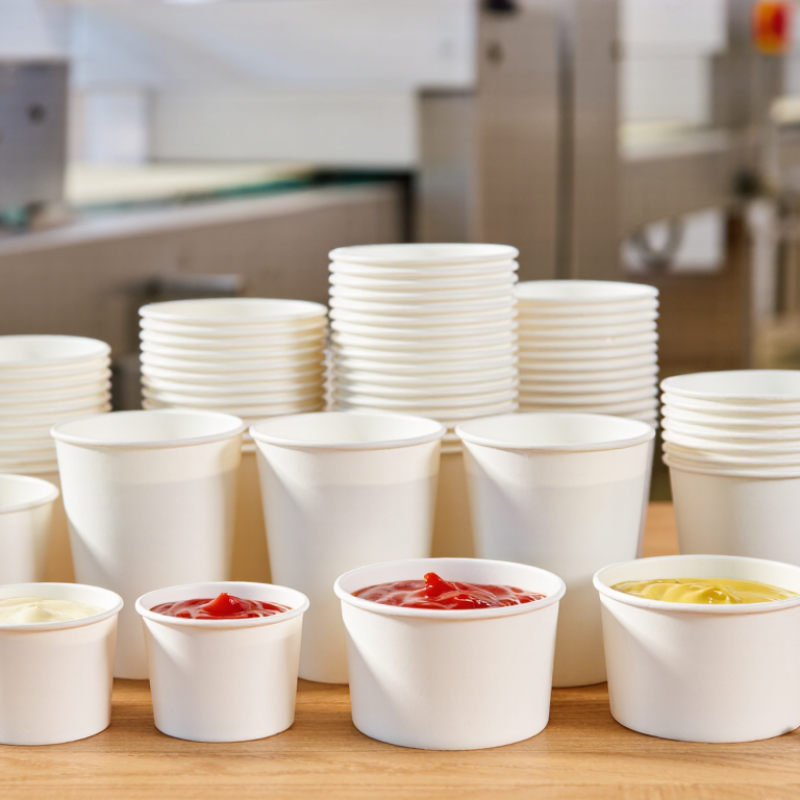
Choosing the best sauce cup paper supplier starts with capacity. A 2 oz cup suits ketchup, dips, and small tasting portions. A 4 oz cup works better for gravy, dressing, or takeaway meals. Ask suppliers for filled samples, not only catalog dimensions. A cup may look correct but hold less after sealing. Measure the inner volume and check the usable fill line.
Board weight affects stiffness and handling. For most sauce cups, 250–350 gsm paperboard offers a practical balance. Lighter board can bend during transport. Heavier board may improve rigidity, but it can increase cost and forming difficulty. Check the rim, base, and sidewall after filling. Cold sauce, warm sauce, and refrigerated storage can behave differently. My experience is that one test condition is never enough.
Tips: Request barrier specifications in writing. Review moisture, oil, and grease resistance. For hot or acidic sauces, ask for temperature and storage test data. Water-based coatings may perform differently from dispersion or other barrier systems. Confirm food-contact documentation, printing safety, and manufacturing consistency. Inspect ten or more samples from different production points. Small variations matter. A supplier may provide excellent prototypes, yet production cups can show uneven rims or weak bottoms. That risk deserves a second review. Supplier reliability also includes clear tolerances, traceable batch records, and realistic delivery times.
Verify FDA 21 CFR 176.170 and EU 1935/2004 Food-Contact Compliance
How to Choose the Best Sauce Cup Paper Supplier?
Choosing a sauce cup paper supplier starts with food-contact evidence, not surface appearance. Ask whether the paperboard, coating, inks, and adhesives meet FDA 21 CFR 176.170 requirements. This regulation covers paper and paperboard components contacting aqueous and fatty foods. Request the supplier’s compliance statement and supporting migration test reports. Confirm the intended conditions of use, including sauce type, temperature, contact time, and storage method. A cup suitable for tomato sauce may not suit oily dressing.
For European markets, verify compliance with EU Regulation 1935/2004. The supplier should provide a clear Declaration of Compliance, traceability records, and information about restricted substances. Good documentation should identify materials and test conditions. “Food grade” alone is too vague. Ask questions.
Practical testing also matters. Fill sample cups with hot curry sauce, mayonnaise, or acidic dressing. Check for softening, leakage, odor transfer, and coating separation after realistic holding times. Review whether the supplier follows suitable manufacturing controls and can maintain consistent batches. In audits, a common mistake is trusting one successful sample. Paper performance can change with humidity, coating weight, or sealing pressure. I would record each result and compare it with the supplier’s declared use conditions. Some reports may look complete but omit fatty-food testing. That gap deserves attention.
Compare MOQ, Lead Times, Print Colors, and Custom Tooling Costs
How to Choose the Best Sauce Cup Paper Supplier?
MOQ can shape your real cost more than the quoted unit price. A 10,000-cup minimum may suit a small restaurant, while a 100,000-cup order can reduce printing costs. However, excess inventory may absorb cash and warehouse space. Ask whether mixed sizes or designs can share one production run. This detail is often overlooked.
Lead times should include artwork approval, sampling, production, and shipping. Request a written schedule with clear dates. For example, twelve production days means little if proof approval takes another week. Add a practical buffer for seasonal demand. Suppliers should explain delays honestly, not promise impossible speed. A sample shipment can also reveal whether the paper feels firm around warm sauces.
Print colors need careful control. Ask for a physical proof, not only a digital image. Screens can make red appear brighter than the final cup. Confirm the color system, ink suitability, surface finish, and print tolerance. A reliable supplier should provide food-contact documentation and quality records. Still, documentation alone does not guarantee consistent output. Inspect the first production batch against the approved sample.
Custom tooling costs require a longer view. A new die or forming tool may be expensive for a small order, but its cost can fall across repeated purchases. Ask about ownership, replacement fees, storage, and reuse conditions. I would not choose the lowest tooling quote immediately. A cheaper tool may create uneven rims or poor lid fitting. My earlier assumption was that higher MOQ always meant better value; actual storage costs proved that wrong.
How to Choose the Best Sauce Cup Paper Supplier? — Compare MOQ, Lead Times, Print Colors, and Custom Tooling Costs
Indicative comparison for printed paper sauce cups and portion containers
| Supplier Profile | Typical MOQ
(pieces) | Sample
Lead Time | Bulk Production
Lead Time | Standard Print
Colors | Custom Tooling
Cost | Tooling Lead
Time | Common Cup
Sizes | Recommended
Order Type |
| Digital-print specialist | 5,000 | 5–7 days | 15–20 business days | 1–4 colors | US$0 | Not required | 1.5–4 oz | Short runs and seasonal promotions |
| Flexographic converter | 25,000 | 7–10 days | 18–25 business days | Up to 6 colors | US$150–450 | 5–8 business days | 1–5 oz | Regular foodservice programs |
| High-volume offset printer | 50,000 | 10–14 days | 20–30 business days | Up to 8 colors | US$300–800 | 7–12 business days | 2–8 oz | Large, repeat purchase orders |
| Stock-size packaging producer | 10,000 | 3–5 days | 10–15 business days | 1–2 colors | US$0 | Not required | 1–4 oz | Fast launches using standard dimensions |
| Custom-forming manufacturer | 30,000 | 12–18 days | 30–45 business days | Up to 6 colors | US$800–2,500 | 15–25 business days | 1–12 oz | Distinctive shapes and proprietary dimensions |
| Premium barrier-paper supplier | 20,000 | 8–12 days | 25–35 business days | Up to 7 colors | US$250–700 | 7–14 business days | 2–8 oz | Greasy, acidic, or leak-sensitive sauces |
Audit FSC, ASTM D6400, and EN 13432 Sustainability Certifications
Choosing a sauce cup paper supplier requires more than checking a green logo. FSC certification should cover the paper fiber, supplier site, and chain of custody. It does not prove compostability. FAO’s 2023 forestry statistics reported global paper and paperboard production above 400 million tonnes in 2022. That scale makes traceable sourcing important, not decorative.
Ask for the FSC certificate number and verify its scope. Then inspect the complete cup structure. ASTM D6400 usually evaluates compostable plastic products under industrial composting conditions. EN 13432 focuses on compostable packaging, including disintegration, biodegradation, and material safety. A paper cup can meet one requirement while failing another. Request test reports for the coating, ink, adhesive, and finished cup. Check the exact product code, laboratory, testing method, and validity date.
European Bioplastics reported global bioplastics production capacity of about 2.2 million tonnes in 2023. Yet certification does not guarantee local composting access. Ask where the cup was tested and where customers can actually compost it. During supplier audits, examine batch records and sample three production lots. Small details matter. I would also challenge vague claims such as “eco paper” without a certificate link. No audit is perfect; translated documents, changed coatings, or expired reports can be missed. That uncomfortable gap deserves written clarification before purchasing.