Skip to content

10 Tips for Choosing a Car Garage Lift for Buyers

A Car Garage Lift can make routine vehicle work more accessible, but choosing one involves more than comparing prices. Buyers need to match the lift to their vehicles, garage, and intended tasks. A model that suits a low sports car may not provide enough clearance for a truck. Begin by measuring ceiling height, door tracks, and the space between parked vehicles. Then check the garage floor and confirm its suitability against the lift manufacturer’s installation requirements. Small details matter.

Compare lift styles with your actual work in mind. A two-post lift can provide access beneath a vehicle, while a four-post model may be useful for storage or certain maintenance tasks. Rated capacity matters, but so do lifting-point placement, arm reach, locking features, and usable height. Read the manufacturer’s specifications, and ask a qualified installer about site preparation, electrical needs, and ongoing inspection. No garage is identical. Even careful measurements can miss a beam or an awkward door swing, so verify clearances before ordering. The ten tips ahead help buyers assess these practical details, compare models responsibly, and ask better questions before making a purchase. They cannot replace a site assessment. A little uncertainty is worth acknowledging: the best choice depends on the vehicle, the workspace, and how the lift will actually be used.
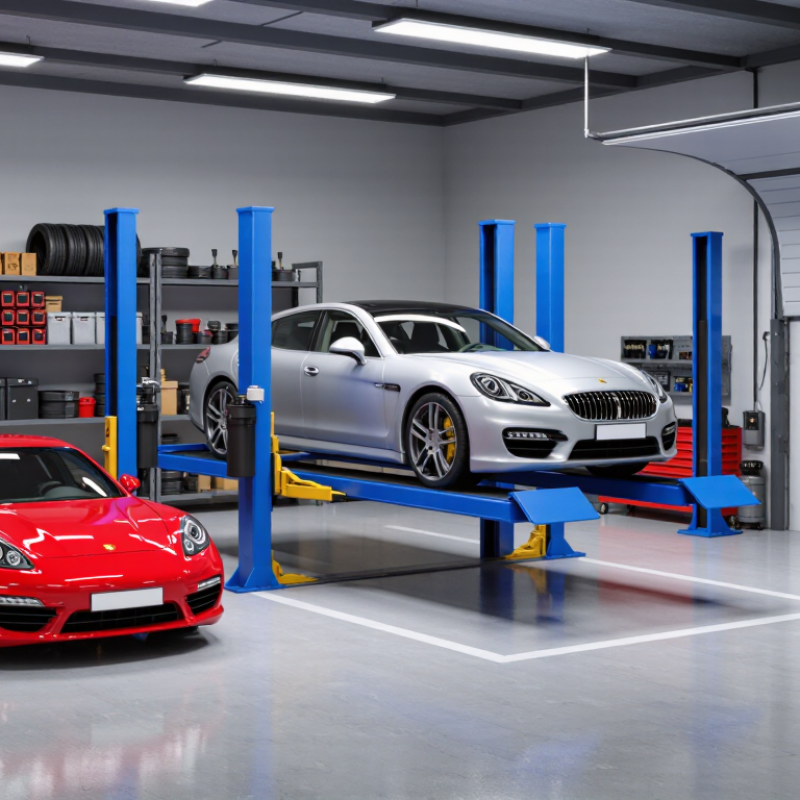
10 Tips for Choosing a Car Garage Lift for Buyers

Define Your Vehicle and Workspace Requirements

Before comparing lift types, measure the vehicles you will actually service. Record each vehicle’s weight, wheelbase, overall length, track width, and highest roof point. The U.S. Environmental Protection Agency’s 2023 Automotive Trends Report puts the average new vehicle’s weight at about 4,329 pounds for model year 2022. That figure is useful context, not a safe capacity target: work trucks, vans, and modified vehicles can weigh much more. Choose a lift rated for your heaviest vehicle, and check the manufacturer’s instructions for how that rating applies to vehicle positioning. Small details matter. A long wheelbase may exceed an adapter’s reach, while low ground clearance can make drive-on ramps impractical.

Measure the workspace too: ceiling height, door clearance, bay width, and the lift’s full operating footprint. Include room for opening doors, placing arms, and walking around a raised vehicle. Check the concrete slab’s thickness and condition against the lift installation requirements; a cracked or unknown slab needs professional assessment, not guesswork. The Automotive Lift Institute’s guidance emphasizes following installation and inspection requirements for the specific lift. Leave extra clearance where possible. It is easy to overlook a garage-door track until a vehicle is halfway up. Recheck your measurements before ordering; I would not trust a tape measure from memory.

Compare Lift Types and Their Intended Uses

A two-post lift suits repairs that need clear access to wheels, brakes, and the underside. Its arms must reach the vehicle’s approved lifting points, and the posts need adequate ceiling clearance. It saves floor space, but careful positioning matters. A small alignment error can make a vehicle feel unstable.

A four-post lift supports the tires along runways, making it useful for storage and routine underbody checks. It is often easier to drive onto, though the runways can limit access to wheels unless accessories are added. For wheel-off work, compare a scissor lift. Low-rise models can fit in modest garages, while full-rise versions need more clearance and a suitable floor. Each design has trade-offs.

Match capacity to the heaviest vehicle you expect to lift, not just your current car. Check the garage floor, ceiling height, doorway, and power supply before comparing prices. Read the installation and maintenance requirements, and confirm that the lift includes clear locking and emergency-lowering instructions. Measure twice. A powerful lift is not automatically the right lift. I would give daily access and safe vehicle positioning more weight than advertised lifting speed. A few inches of clearance can decide whether a lift works comfortably or becomes an obstacle.

Check Capacity, Safety Features, and Build Quality

A car garage lift should be selected by its actual working capacity, not by a vehicle’s advertised curb weight alone. Check the lift’s rated load against the heaviest vehicle you expect to service, including tools or cargo that may remain inside. Also consider where the vehicle’s weight sits; vans and electric vehicles can load the lifting points differently. A little extra capacity is sensible, but it does not make poor positioning safe. Small details matter.

Safety features deserve close inspection. The Automotive Lift Institute’s safety materials cite an estimated 15 lift-related fatalities and 26 serious injuries each year, figures commonly used to highlight the risks of improper operation and maintenance. Look for positive mechanical locks, secure arm restraints, clear load-point guidance, and smooth synchronization between columns. ANSI/ALI ALCTV sets requirements for lift testing and certification; verify that the specific model is certified, rather than relying on a seller’s general claim. Then inspect welds, steel thickness, cables or chains, and the finish for signs of weak construction or corrosion. Ask what concrete thickness and anchoring are required, and have the installation checked by a qualified technician. I have seen buyers focus on glossy paint and overlook the floor. It is an easy mistake. Safety locks also need regular inspection, not just a quick glance when the lift is new.

Assess Installation Needs and Available Garage Space

Before comparing lift models, measure the garage as it is—not as you remember it. Record ceiling height, clear width, door-track position, and the distance from the parking spot to the walls. A tape measure and a chalk outline can reveal awkward pinch points. Measure twice. Include the vehicle with its hood and trunk open, plus room to walk around it. A tall SUV may fit under the ceiling yet leave too little headroom to raise safely. Check beams, lights, openers, and hanging storage; these often steal usable clearance.

Then inspect the floor and plan the installation path. Look for cracks, slopes, drains, and floor joints near the planned support posts. Concrete can look solid and still be unsuitable. Have a qualified installer check the slab’s thickness and condition against the lift specifications. Check the delivery route, too. A low door header or narrow side entrance may block equipment during installation. Leave room to work. Think through power needs and anchoring requirements before scheduling the job. If your measurements are close, pause and recheck them; that small delay is better than forcing a poor fit.

Compare Total Costs, Warranty, and Ongoing Support

When comparing car garage lifts, look beyond the purchase price. Ask for an itemized quote covering delivery, installation, electrical work, and floor preparation. A lower-priced lift may require a thicker concrete slab or special anchoring, adding costs before the first vehicle goes up. Get it in writing.

Check what the warranty actually covers. Frame coverage, hydraulic components, and labor may have different terms, and exclusions can matter more than the headline duration. Ask whether travel, replacement parts, and technician time are included. Keep the answer. Confirm who handles claims and how quickly parts are usually shipped; a lift waiting for a small seal can leave a bay unusable. “Limited warranty” is not much detail.

Ongoing support has a cost, even when it is missing from the invoice. Ask about inspection schedules, lubrication points, staff training, and service documentation. If support is remote, check that instructions are clear enough for your team to follow safely. A low annual service estimate may exclude call-out fees. Compare realistic costs over several years, not just year one. Your usage estimate may be off, so track weekly lift cycles and revisit the budget.

10 Tips for Choosing a Car Garage Lift for Buyers — Compare Total Costs, Warranty, and Ongoing Support
# What to Compare Practical Checks Cost or Specification Guide Warranty and Ongoing Support
1 Lift capacity Check the vehicle’s gross weight, not just its curb weight. Allow capacity for the heaviest vehicle you expect to service. Common light-vehicle lifts are rated around 7,000–12,000 lb; verify the rating on the lift’s documentation and data plate. Confirm the warranty applies when the lift is used within its rated capacity and installed as specified.
2 Lift style and use Choose based on the work: two-post lifts provide underbody access; four-post lifts can suit storage and service; scissor lifts can save space. Indicative equipment-only U.S. price ranges: two-post, about $3,000–$6,000; four-post, $3,500–$7,000; scissor, $2,000–$5,000. Ask whether the supplier can support the specific lift configuration and provide compatible replacement parts.
3 Full project cost Request an itemized quote that includes delivery, unloading, installation, electrical work, permits if required, and any accessories. Installation may add several hundred to a few thousand dollars, depending on site preparation, freight, and local labor. Treat equipment prices as estimates, not quotes. Get in writing which installation tasks are covered and whether installation by an approved technician is required for warranty coverage.
4 Slab and foundation requirements Check the manufacturer’s concrete thickness, strength, age, and anchoring requirements before ordering. Have the slab assessed if its condition is uncertain. Requirements differ by model and installation; there is no single slab specification that is suitable for every lift. Confirm that site conditions meet the installation manual; unsuitable concrete can affect safe installation and warranty terms.
5 Garage height and clearances Measure ceiling height, door tracks, lights, beams, and the tallest vehicle. Check the lift’s overall height and required operating clearance. Compare the published overall height and maximum rise with your measured space; account for vehicle height and overhead obstacles. Ask support to review your measurements and the lift layout before purchase, especially in a low-ceiling garage.
6 Power supply and operating needs Check the motor’s voltage, phase, and electrical requirements against the available supply. Do not assume a particular circuit is suitable. Electrical specifications vary by model; confirm them from the installation manual and have electrical work completed to local code. Verify whether troubleshooting, wiring diagrams, and technical assistance are available after installation.
7 Safety features and compliance Review mechanical locks, lock engagement, arm restraints where applicable, emergency lowering procedures, and the operating instructions. Compare documented safety features and applicable standards for the lift’s intended use and location; do not rely on capacity alone. Ask for written inspection and maintenance guidance, plus access to replacement safety components.
8 Warranty coverage Read the written warranty for covered parts, labor, exclusions, claim steps, and whether coverage changes for commercial use. Warranty periods and coverage vary by component and seller; compare the actual written terms rather than a single headline duration. Check who handles claims, who pays freight or labor, and whether registration or professional installation is required.
9 Parts availability and maintenance Ask about the availability and expected replacement process for wear items such as hydraulic hoses, seals, cables, and rollers. Include routine inspections, lubrication, and any service visits in your ownership-cost estimate; follow the model’s maintenance schedule. Confirm parts can be ordered individually and ask for typical dispatch times and access to service documentation.
10 Seller support and delivery Confirm delivery access, unloading arrangements, installation responsibility, and who to contact for technical questions. Freight, lift-gate service, and unloading equipment may be charged separately; request these costs before placing an order. Compare support hours, technician availability in your area, response process, and the procedure for reporting shipping damage.
Planning note: Price figures are approximate U.S. equipment estimates and can change with capacity, configuration, freight, and location. Obtain current written quotes and verify all site, electrical, safety, warranty, and installation requirements for the exact lift model.

“Guardian has been a tremendous help in providing storage and distribution solutions for AIR Global. We came to Guardian with a need, and they quickly found a solution for us at a very reasonable price. Our business is very demanding, especially during busy periods, and Guardian has been flexible and able to accommodate all requests with less than 48 hours’ notice. April, our main contact, has been extremely helpful in making sure our orders are shipped on time and that our inventory is accurate. I highly recommend using Guardian and look forward to continuing our relationship for many years to come.”

Matt Buffington
Director of Supply and Operations
Americas

“The Guardian Logistics Team is responsive and helpful on a consistent basis.  This removes a tremendous amount of stress and gives us incentive to route cargo that will touch your dock. Thanks for all that you do!!!”

Charles Reel
Branch Manager
Scan Global Logistics

“I recommend with great confidence, Guardian Logistics Solutions and owner, Brent Smith to whomever needs top shelf deliveries including Last Mile, White Glove, Residential and Commercial.

I have known GLS since its inception. Guardian is always looking for the right answer to solve the customer’s problem. I can, without hesitation, recommend Guardian Logistics to any company that is looking for the best service in their coverage area. They will team with you to create a solution that suits your needs and ensure you are satisfied with the outcome.”

Steven T. Nelson

“I highly recommend Guardian Logistics Solutions. The professionalism and communications offered by the team, along with speediness, cost saving solutions and attitude is a testament to the fact that this is one of the most important partners you can have in the freight movement business.

The company offers exemplary service, they continuously exceed our expectations and that of the importers, they help us service, Guardian Logistics Solutions is the best solid business partner you should add to your company.”

Ubaldo Sierra
Maersk Customs Brokers
General Manager

“Guardian Logistic Solutions is one of those rare companies who under-promise-and-over-deliver EVERY single time!”

James Burke
Manager, Sales Team
OLIMP Warehousing

“I want to thank the team at Guardian for the excellent service we have received.
The shipments have been professionally handled and freight arrives timely and in good order at a fair price. Communication is a very important part of the handling and Guardian does a great job of communication through the delivery.”

Cheri Zetrouer
Access Worldwide
Customs Brokers & Freight Forwarders

“I am very lucky to have found Guardian Logistics to help with our freight needs.  Our business is a bit unique in that we only receive a shipment every 2-3 months and we have to stick to a very strict time schedule in order to unload the delivery.  We found it virtually impossible to consistently coordinate with logistics companies to have shipments arrive on time and when they were expected. After multiple frustrating scenarios, our broker introduced us to Guardian Logistics who handled all of our shipments recently to perfection. Our shipments have arrived on time, when expected, with friendly and helpful drivers.  We will only be using Guardian moving forward for all of our shipping and freight needs. I couldn’t recommend them strongly enough!”

Trey Conrad
Owner
Patriot Power Source

“We have been working with the Guardian company for several years now and I can say without a doubt that their entire team cares about the service they provide. Their personal interest in their customers’ success makes them a standout in the world of final mile delivery.

I highly recommend Guardian for anyone requiring outstanding services in warehousing and final mile delivery programs.”

Frank Ianucilli
Director of Final Mile Operations
Werner Enterprises

“At WeFixFreight.com, client satisfaction is our main priority.  We are proud to partner with the top notch team at Guardian to bring our customers nothing but the best service when it comes to freight reworks, cross docking services, and final mile delivery.”

Bill Carlin
CEO
WeFixFreight.Com

“The Guardian Logistics staff has always been exceptional, and these days, with all the competition out there, it’s the service that matters. We appreciate all they do and look forward to continuing our business with GLS.”

Cathy Avolio
Ocean Import Manager
Mallory Alexander Int'l Logistics (NY), LLC
Back To Top