How to Source U100 Dried Mango Wholesale Globally?
Sourcing u100 dried mango wholesale globally requires more than comparing prices on a supplier website. Buyers must understand the product definition, processing method, origin, and intended market before requesting quotations. The term “U100” may describe a specific grade, count, or internal supplier standard, so its meaning should be confirmed in writing. Ask for a product specification sheet, recent laboratory reports, allergen information, and clear photographs of the packed mango.
Reliable sourcing depends on practical verification. Experienced buyers usually compare several producers, not only trading companies. A factory audit, video inspection, or trusted third-party assessment can reveal important details, including hygienic handling, drying equipment, storage temperature, and carton conditions. Samples should be tested for texture, moisture, color, sweetness, sulfites, and foreign materials. A bright sample may still fail after several weeks in a humid warehouse. Packaging matters too. Inner liners, lot codes, shelf-life dates, and shipping marks should match the purchase agreement.
Global shipments also require careful document control. Confirm the supplier’s business registration, food-safety certifications, export experience, and ability to meet the destination market’s labeling and import requirements. Incoterms, payment stages, inspection rights, and claims procedures deserve equal attention. No sourcing plan is flawless. A low price can hide unstable quality, while a famous origin cannot guarantee every batch. Treat each shipment as evidence, review performance honestly, and improve the next order. Small details often protect the largest investment.
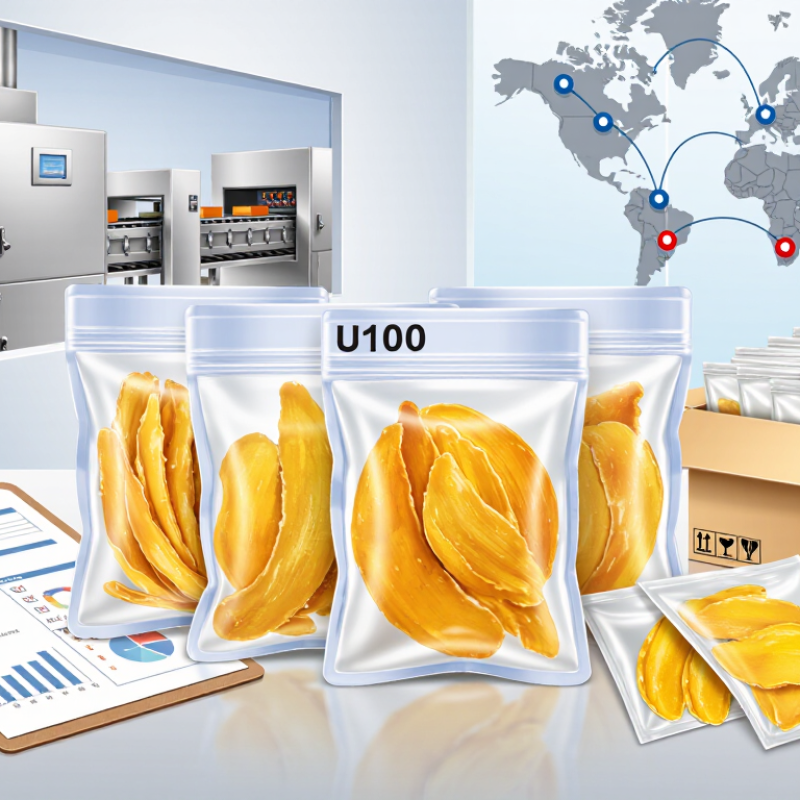
Defining U100 Dried Mango Specifications and Quality Standards
How to Source U100 Dried Mango Wholesale Globally?
Defining U100 clearly prevents costly disputes. In dried mango trade, U100 commonly means fewer than 100 pieces per pound, but this grade is not globally standardized. Buyers should specify slice weight, length, thickness, and count method. A 500-gram sample can reveal more than a supplier’s photograph. Record whether pieces are whole, broken, sugared, or naturally dried.
Moisture and water activity control texture and safety. Commercial specifications often target moisture around 15–20%, while water activity below 0.60 helps restrict microbial growth. These values must be verified by laboratory testing, not assumed from appearance. The FDA’s preventive-control framework emphasizes hazard analysis, sanitation, and documented monitoring. Codex Alimentarius General Standard for Contaminants also supports controlled limits for chemical and biological hazards. Small differences matter.
Check the harvest year. Check the test date. FAOSTAT data shows global mango, mangosteen, and guava production exceeded 60 million tonnes in 2022, increasing the need for consistent post-harvest controls. Yet production volume does not guarantee export quality. Require certificates for moisture, water activity, sulphites, pesticide residues, and microbiology. Verify laboratory accreditation when possible. I have seen specifications that sounded exact but missed oil migration from packaging. That is a practical weakness. Use food-grade barrier bags, sealed cartons, and traceable lot codes. Allow realistic tolerances for colour, fibre, and broken pieces. U100 should describe measurable product value, not merely a sales phrase.
Identifying Reliable Global Dried Mango Wholesale Suppliers
Reliable U100 dried mango suppliers require more than attractive pricing. If U100 means a 100-gram retail unit, confirm the definition in writing. Product codes vary across exporting markets.
Grand View Research estimated the global dried fruit market at about USD 10.5 billion in 2023. This indicates strong demand, but market size does not prove supplier quality. Use ITC Trade Map to review dried mango trade flows under HS 080450. However, this code also includes guavas and mangosteens, so its data needs careful interpretation. Do not treat shipment volume as a quality certificate.
Request a recent specification sheet, product photographs, batch records, and a certificate of analysis. Check moisture, sulfur dioxide, microbiological limits, added sugar, allergens, and foreign-material controls. Ask whether testing covers the exact production lot. Trace every lot. Require samples from the same facility that will manufacture the order. A good sample can still be misleading.
Reliable suppliers should explain orchard sourcing, drying temperature, packaging materials, shelf life, and corrective actions. Review independent audit reports, not only self-declarations. Verify the legal company name and export documents through official registries. Also compare payment terms, production capacity, lead time, and recall procedures.
I would not choose the cheapest offer quickly. A lower quote may hide inconsistent fruit size, excess moisture, or weak packaging. Supplier screening is never perfect. Recheck performance after each shipment, because one successful delivery proves very little.
Comparing Prices, Certifications, and Minimum Order Requirements
How to Source U100 Dried Mango Wholesale Globally?
U100 dried mango pricing is difficult to compare without a clear size definition. Some suppliers use U100 for fewer than 100 pieces per pound, while others apply different grading methods. Confirm the count, slice weight, moisture level, and cut style in writing. Request prices under the same terms, such as FOB, CIF, or delivered cost. A low FOB quote may become expensive after freight, customs, inspection, and local handling fees. Ask for a recent sample before judging value.
Certifications deserve careful checking. Request valid food safety certificates, audit dates, scope, and the certified processing site. Depending on the destination, buyers may require HACCP-based controls, ISO 22000, organic documentation, or retailer-specific approval. Test reports should cover moisture, microbiology, pesticide residues, sulfites, and undeclared allergens. Certificates alone are not enough. I have seen documents that looked complete but did not match the shipment facility.
Minimum order requirements can change the real price. One supplier may accept 300 kilograms, while another requires a full container. Compare pallet quantity, carton size, private packaging, and mixed-product flexibility. Ask whether the MOQ applies to each flavor, package, or total order. Smaller trial orders usually cost more per kilogram, but they reduce the risk of uneven color, tough texture, or excessive sugar. My own sourcing mistake was focusing too heavily on unit price. The cheapest offer was not the most reliable one. Payment terms, replacement policies, and production lead times also need written confirmation.
How to Source U100 Dried Mango Wholesale Globally?
Comparing indicative prices, certification coverage, and minimum order requirements
Indicative export benchmarks for 100% mango or unsweetened dried mango specifications. Average prices are shown in USD per kilogram, minimum order quantities in kilograms, and certification coverage represents commonly requested food-safety and market-access certifications available from qualified suppliers. Final quotations vary by cut, moisture level, packaging, season, shipment terms, and destination.
Managing International Shipping, Customs, and Wholesale Delivery Terms
How to Source U100 Dried Mango Wholesale Globally?
International sourcing of U100 dried mango starts with a precise product definition. Confirm what “U100” means, including fruit size, moisture level, sugar treatment, and permitted additives. Ask for a recent specification sheet, laboratory report, and production photos. A pre-shipment sample should match the approved reference, not merely look similar. Small differences matter.
Shipping terms shape the real wholesale cost. Under FOB, the buyer usually manages ocean freight and insurance from the named port. Under CIF, the seller arranges freight and basic insurance, but destination charges may remain unclear. DDP can simplify delivery, yet it requires careful confirmation of import responsibilities and local tax handling. Put every term in writing, including the named place, carton count, pallet design, temperature requirements, and delivery window.
Customs clearance depends on accurate documents. The commercial invoice, packing list, certificate of origin, health documents, and transport record must show consistent product details. Check the destination’s current rules before loading. A tariff code should be confirmed with a qualified customs professional, because classification errors can delay a container. Use moisture-resistant cartons and inspect seals when the shipment arrives. I have seen buyers focus on the unit price, then lose money through storage fees and port delays. That mistake is easy to repeat. Payment milestones, inspection rights, claims deadlines, and responsibility for damaged cartons should be agreed before production begins.