What Are Granite Air Bearings and How Do They Work?
granite air bearings support precision motion with an almost invisible cushion of compressed air. They are commonly paired with granite machine bases, coordinate measuring machines, optical stages, and inspection equipment. Their purpose is simple: reduce contact, friction, and mechanical wear while preserving accurate movement.
A typical system uses a porous bearing surface or carefully drilled air outlets. Pressurized air passes through this surface and forms a thin film between the bearing and the granite guideway. The moving component then floats slightly above the stone. No direct contact occurs during normal operation. That small gap matters.
Granite provides stiffness, thermal stability, and a finely lapped reference surface. Air provides smooth, clean motion without oil contamination. Together, they can deliver excellent straightness and repeatability in demanding environments. However, performance depends on air pressure, surface quality, load distribution, and proper alignment. The stone must be clean. The air must be stable.
In practice, engineers verify these factors with pressure tests, flatness measurements, and repeatability checks. A bearing may look perfect yet perform poorly if its air film is uneven. That detail is easy to underestimate.
This guide explains what granite air bearings are, how their air film works, and why granite is used as the supporting reference. It also examines practical limits, maintenance needs, and design choices. The discussion remains technical but accessible. Some applications need more careful analysis than a simple explanation suggests.
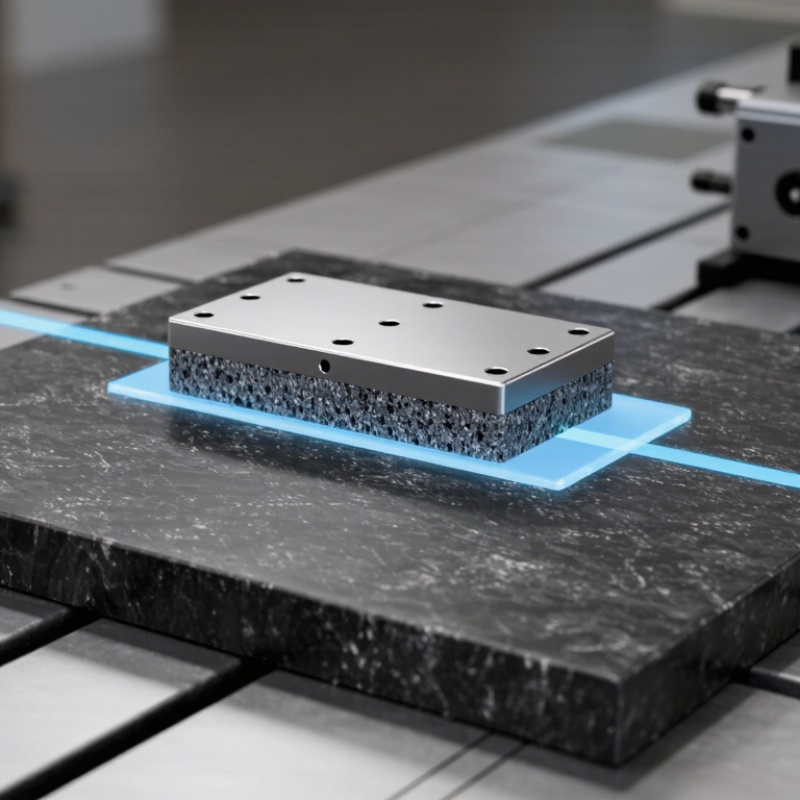
Granite Air Bearings: Definition and Core Components
Granite air bearings are precision support devices that use a thin film of compressed air between two surfaces. The air film prevents direct contact, reducing friction, wear, and vibration. Granite provides a rigid, stable base with strong resistance to thermal movement. This matters in coordinate measuring machines, optical stages, and high-accuracy manufacturing equipment.
The core components include a granite guide surface, an air-bearing pad, restrictors, supply channels, and a controlled air source. The pad contains small outlets that distribute air evenly across the working gap. Restrictors regulate flow and help maintain stiffness when loads change. A typical gap may be only a few micrometers, so dust, moisture, and poor leveling can affect performance. During installation, technicians should inspect the stone surface, verify air pressure, and measure motion with appropriate instruments. Small errors become visible quickly. That is easy to underestimate.
Tips: Keep the compressed air clean and dry. Check filters before troubleshooting the bearing. Avoid touching finished surfaces with bare hands. Oil or fine dust can disturb the air film. Allow the granite structure to reach room temperature before calibration. This step is often skipped, yet it can improve repeatability. Designers should also match bearing area and air pressure to the expected load. More pressure is not always better. A larger pad may improve stability, but it can also increase air consumption and expose weaknesses in the support structure. Testing under real operating conditions remains essential.
How Pressurized Air Creates Near-Frictionless Motion
What Are Granite Air Bearings and How Do They Work?
Granite air bearings combine a precision granite surface with a thin pressurized-air film. Air enters through small restrictors in the bearing pad. The film lifts the moving stage slightly above the granite, removing direct contact. Motion then becomes extremely smooth, with very little mechanical friction or wear.
The air gap may measure only several micrometres. That small distance demands a remarkably clean and stable surface. Granite helps because it resists thermal expansion and provides strong geometric stability. However, “near-frictionless” does not mean perfect. Air turbulence, surface contamination, vibration, and pressure variation still affect accuracy. In practical testing, engineers must monitor both motion quality and air consumption. The U.S. Department of Energy’s Improving Compressed Air System Performance report notes that leaks can waste 20–30% of compressor output in industrial systems. That loss can quietly increase operating costs. The bearing may move beautifully, yet the air system may perform poorly.
Tips: Keep filtration, pressure, and granite cleanliness under control. Check air gaps regularly. A single dust particle can disturb a micrometre-scale film. Use pressure sensors near the bearing, not only at the compressor. This reveals local pressure drops. Also, question the ideal specifications. Real workshops are rarely dust-free, perfectly level, or thermally stable. DOE guidance supports routine leak inspections and system maintenance for better compressed-air efficiency.
The Role of Granite Surfaces in Bearing Performance
What Are Granite Air Bearings and How Do They Work?
Granite air bearings use a thin, pressurized air film to support moving components without direct contact. The granite surface acts as a stable reference and a precise running track. Its fine, dense structure resists wear and helps maintain consistent geometry over time. Air exits through carefully arranged pores or restrictors, creating an even cushion between the bearing and granite. The gap may be only a few micrometres wide.
Surface quality matters greatly. A granite plate must be exceptionally flat, smooth, and clean. Small scratches can disturb airflow or create local pressure changes. Temperature stability is another advantage, because granite expands less than many metals under ordinary workshop conditions. It also absorbs vibration, which can improve measurement accuracy near motors or cutting equipment. Even dust from a nearby operation may affect performance.
Granite is not automatically perfect. Poorly finished edges, trapped moisture, or uneven support can reduce bearing stiffness. That detail is easy to underestimate. Engineers usually check flatness, surface waviness, air pressure, and load capacity together, rather than judging the stone by appearance. A dark, polished surface may look precise yet perform poorly. Design reviews should also consider cleaning access and long-term leveling. In practice, the best results come from matching granite quality with restrictor design, airflow control, and realistic operating loads.
Common Designs and Applications of Granite Air Bearings
Granite air bearings use compressed air to create a frictionless gap between precision surfaces. The air exits through tiny pores or drilled orifices. This film supports moving components without direct contact. Granite provides strong dimensional stability and excellent damping. It also resists thermal changes better than many metals. Still, granite is not perfectly rigid. Uneven loading can cause small alignment errors.
The flat-pad design is common in linear stages and measuring platforms. It supports motion across a broad, polished granite surface. V-shaped designs guide movement from two opposing faces. They help control yaw and side-to-side drift. Cylindrical or rotary designs support round tables and scanning mechanisms. Porous air pads provide smooth pressure distribution. Orifice-based pads can offer higher stiffness, but they need careful pressure control. The choice is rarely simple.
Granite air bearings serve coordinate measuring machines, optical inspection systems, semiconductor equipment, and precision machine tools. Their noncontact motion protects delicate surfaces from wear and particles. Clean, dry air is essential. Filters, regulators, and pressure sensors require regular checks. Engineers also map surface errors during installation. A perfect granite surface is an unrealistic expectation. Temperature gradients, vibration, and air turbulence can still affect results. In demanding systems, preload and active control may be necessary to maintain stable motion.
What Are Granite Air Bearings and How Do They Work?
Granite air bearings support and guide precision stages on a thin film of pressurized air. The granite surface provides a stable, low-thermal-expansion reference, while the air film eliminates mechanical contact, friction, and lubricant contamination.
The chart shows representative mid-range air-film gaps commonly used in precision air-bearing designs. Actual values depend on bearing size, supply pressure, restrictor geometry, preload, load, and required stiffness.
Orifice-Restricted Bearings
Small precision orifices meter compressed air into the bearing surface. They are commonly used for coordinate-measuring machines, inspection stages, and linear motion systems.
Porous-Media Bearings
Air flows through a porous restrictor, producing a distributed and uniform air film. This design is useful where smooth motion, low vibration, and high surface conformity are important.
Vacuum-Preloaded Bearings
Vacuum force holds the bearing against its reference surface while compressed air creates separation. This arrangement supports bidirectional stiffness in precision positioning and optical inspection equipment.
Key Benefits, Limitations, and Maintenance Considerations
Granite air bearings support moving parts on a thin cushion of compressed air. Tiny pores or precision nozzles release air across a polished granite surface. The moving stage then floats with almost no mechanical contact. This design reduces friction, vibration, and particle generation. It also offers stable motion for measuring equipment, optical systems, and precision manufacturing tools.
The main benefit is repeatable positioning. Granite provides strong dimensional stability and absorbs some structural vibration. Air cushioning removes rolling-element wear and can produce exceptionally smooth travel. The limitations deserve equal attention. The bearing needs clean, dry, regulated air at all times. A pressure drop can cause contact within seconds. Granite is rigid, but it can chip under impact. Large systems may also require careful leveling and costly installation. Perfect performance is not automatic.
Maintenance is simple in principle, yet easy to neglect. Use fine filtration, monitor pressure, and check moisture traps regularly. Wipe exposed surfaces with a lint-free cloth. Never drag metal tools across the granite. Inspect air outlets for blockage, especially in dusty rooms. A small leak may appear as uneven motion or a faint hiss. Record pressure readings and positioning errors over time. One practical lesson is uncomfortable: operators often clean the surface but ignore the air supply. That mistake can shorten bearing life and distort measurement results. Recalibration may be necessary after relocation, leveling work, or accidental impact.
