How to Choose a Carbon Fiber Tube in 2026?
Choosing a carbon fiber tube in 2026 is not just a matter of picking the lightest option. The right tube depends on the job: a camera boom, robotic arm, or outdoor frame each faces different loads and conditions. Fit comes first. Measure the required length, outer diameter, wall thickness, and connection points before comparing products. Small details count. A few millimeters of clearance can affect assembly, while a poorly matched clamp can crush a thin wall.
Material descriptions can sound similar, but construction matters. Check whether the tube is pultruded or roll-wrapped, and ask how its fiber orientation supports bending, torsion, or compression. Review the supplier’s technical data for dimensions, tolerances, resin type, and stated test methods. For critical applications, request traceability documents and test a representative sample under realistic conditions. Do not treat a headline strength value as a complete design answer. That matters.
The selection process also involves trade-offs. A thicker wall may improve stiffness, yet add weight and cost; a custom layup may suit one load direction but perform differently in another. There is no universal winner. Temperature, moisture, UV exposure, impact risk, and the planned joining method deserve attention too. Compare complete specifications, not marketing labels alone, and confirm that the supplier can maintain consistent dimensions. I would still verify a sample before committing to a large order. A careful choice starts with the actual use case, not the most impressive product claim.
What Is a Carbon Fiber Tube and How Is It Made?
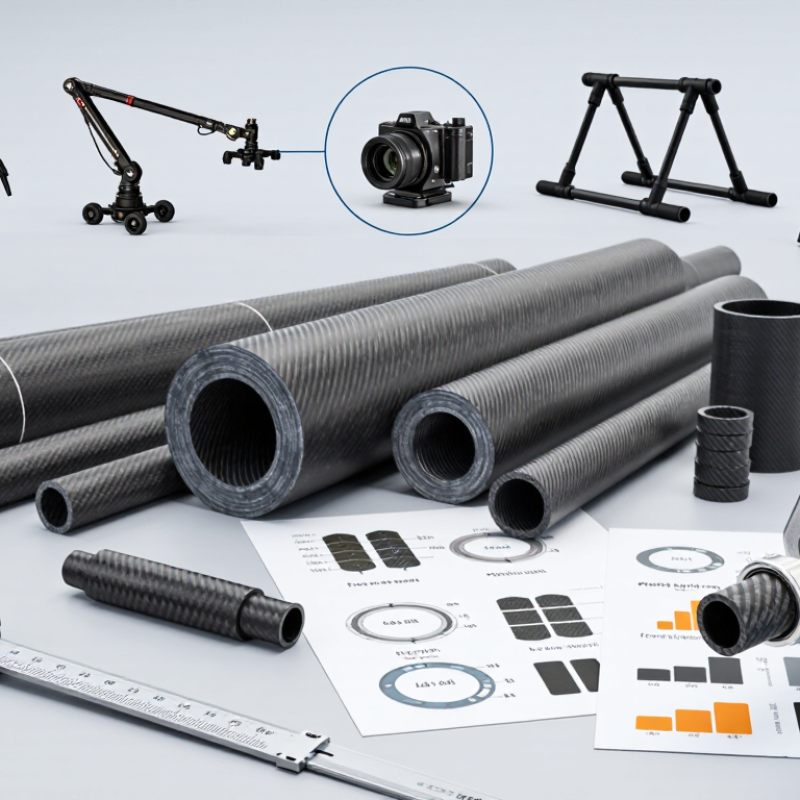
A carbon fiber tube is a hollow composite part, not a solid piece of carbon. Thin carbon fibers carry much of the load, while a resin matrix binds them together and helps transfer stress. The tube’s stiffness and strength depend on fiber direction, resin content, wall thickness, and the quality of the finished laminate. A tube with fibers running lengthwise behaves differently from one reinforced around its circumference. That matters.
Manufacturers commonly form tubes by wrapping resin-impregnated fiber around a removable or permanent mandrel. Other methods include pultrusion, which pulls fibers through resin and a shaping die, and filament winding, which lays continuous fibers along controlled paths. The layup is then cured with heat, pressure, or both, depending on the material and process. After curing, the tube may be trimmed and inspected for dimensions, surface defects, and variation in wall thickness. Not magic.
Each method creates trade-offs. Pultrusion can produce consistent, straight tubes, but may offer less flexibility in fiber orientation. Wrapped or wound construction allows more tailored reinforcement, though workmanship and process control matter. Small voids or uneven resin can weaken a part, even when its surface looks smooth. In choosing a tube, check its intended load, fiber orientation, dimensions, and test data. I would treat a datasheet as a starting point, not a guarantee; real performance also depends on how the tube is supported, drilled, and joined.
Which Tube Properties Matter for Your Application?
A carbon fiber tube should be selected by the loads and conditions it will actually face, not by appearance alone. Start with the required length, outer diameter, and wall thickness. These dimensions affect bending stiffness, weight, and fit. A thick wall may seem safer, but it can add weight without solving the real problem.
Load direction matters. Tubes with fibers aligned along their length often perform well under axial loads, while bending or twisting may require different fiber orientations. Check the manufacturer’s data for stiffness and strength, and note how each value was tested. A tube used as a camera support, for example, may need to resist bending when extended, not just carry a static weight. Short test loads can be misleading. Real use includes vibration.
Consider the connection points, too. Clamps and drilled holes can concentrate stress, so confirm that the tube is compatible with your fittings. Temperature, moisture, and repeated impacts may also affect performance. If the application is safety-critical, have a qualified engineer review the design and test a representative assembly. Specifications do not tell the whole story. There is always some uncertainty between a lab test and the finished setup.
How Do Tube Shape, Size, and Layup Affect Performance?
A carbon fiber tube’s shape influences how it carries load and fits into an assembly. Round tubes are common for shafts and booms because they resist bending from different directions reasonably well. Square or rectangular tubes can simplify mounting, but their stiffness varies with orientation. A flat face may make bolting easier. It can also concentrate stress around holes, so check the connection details, not just the tube dimensions.
Size matters. A larger outside diameter can improve bending stiffness without adding much material, while wall thickness affects weight, local crushing, and buckling resistance. Compare the actual inside and outside diameters with the available space and expected loads.
Layup matters too: fibers aligned along the tube provide strong axial performance, while angled or hoop layers help with torsion and splitting resistance. Ask for the layup schedule and test data when the application is demanding. “Carbon fiber” alone tells you too little.
One practical mistake is choosing by weight before checking how the tube will be supported. A short, simply supported section may behave very differently from a long tube clamped at one end. Test a representative assembly if possible; I would not assume a catalog stiffness predicts every real setup.
How to Compare Manufacturing Methods and Quality Standards
Choosing a carbon fiber tube means matching its construction to the load, shape, and finish you need. Pultruded tubes are often consistent in length and straightness, making them useful for repeated, mostly axial loads. Their fiber direction can limit performance when forces come from other angles. Fit matters more. Roll-wrapped tubes allow more control over fiber orientation and wall thickness, but specifications vary with the layup and curing process.
Filament winding can suit tubes designed for particular load paths, especially when fibers need to follow a controlled pattern. Compare methods using the actual application, not a label alone. Ask for drawings that show dimensions, fiber orientation, and tolerances. Check the cut ends for fraying, inspect the surface for uneven resin or visible voids, and measure straightness and wall thickness. A clean surface proves little about hidden defects.
Quality standards help only when their scope is clear. A supplier’s quality-management certification does not, by itself, confirm that every tube meets your design requirements. Request the applicable test methods, acceptance limits, inspection frequency, and batch traceability. For critical parts, specify how strength, dimensions, and environmental resistance will be verified. Test reports should identify the sample and method. Not always obvious. Comparing suppliers can still be awkward when they report results differently, so agree on one measurement method before ordering.
How to Select a Carbon Fiber Tube for Your Project in 2026?
How to Choose a Carbon Fiber Tube in 2026?
Selecting a carbon fiber tube starts with the job it must do, not its appearance. Define the load, unsupported length, and acceptable deflection. A lightweight tube may still bend too much across a long span. For a small camera support, for example, check how much the tube flexes with the camera mounted, not just its listed strength.
Match the tube’s diameter, wall thickness, and fiber layup to those demands. Fibers mainly resist loads along their direction, so a tube designed for bending may not suit heavy twisting. Ask for technical data that specifies dimensions, tolerances, and test conditions. Compare values measured in similar ways. If a joint uses a clamp, check that tightening it will not crush the tube. Small details matter.
Consider temperature, moisture, impact, and how the tube will be cut or joined. Carbon fiber can be stiff yet vulnerable to localized damage, especially around drilled holes or sharp edges. Inspect the finished tube, and test a sample under realistic conditions when the consequences of failure are significant. One honest uncertainty: a neat calculation may miss a loose fitting or uneven load. Leave room for those real-world imperfections, and get engineering review for critical structures.
