
Skip to content

How to Choose the Right Steel Grating for Sale?

Choosing the right steel grating for sale begins with the site, not the product photograph. A walkway beside a cooling tower faces different demands than a warehouse mezzanine. Measure the clear span, support direction, traffic pattern, and surrounding moisture. Then identify whether people, carts, forklifts, or heavy equipment will cross the surface. Small details matter. A 30-millimeter opening may support drainage, but it can challenge small wheels or narrow heels. The correct choice balances safety, load capacity, grip, maintenance, and budget.

Reliable selection depends on verifiable specifications. Check bearing bar depth, thickness, spacing, cross-bar pitch, panel dimensions, and surface finish. Load tables should state span conditions and deflection limits, rather than provide vague weight claims. Serrated bars can improve traction in wet areas. Galvanizing can support corrosion resistance, but coating quality and exposure still deserve inspection. Stainless steel may suit aggressive environments, although its price requires careful justification. Ask for drawings, material grades, test records, and consistent tolerances from a qualified supplier. An experienced fabricator should explain assumptions plainly. If an answer sounds effortless, ask why.

I once treated a low-cost panel as an easy solution. That shortcut was wrong. The opening looked suitable, yet the support layout created unnecessary flex. Revisiting the measurements prevented a costly replacement. This experience shows why buyers should compare actual site conditions with engineering data. Confirm edge panels, fixing clips, cutouts, delivery protection, and installation guidance before ordering. Review samples when appearance and walking comfort matter. A trustworthy supplier will welcome practical questions and admit limitations. Your decision should be documented, checked, and suitable for daily users. Good steel grating is not merely strong. It must fit the real job.
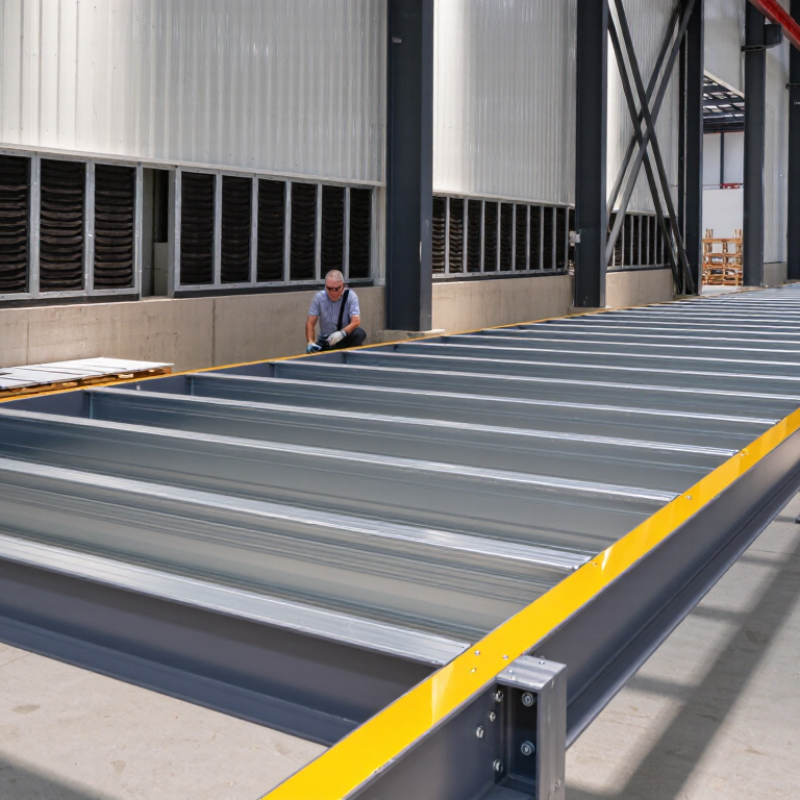
How to Choose the Right Steel Grating for Sale?

Define Load Class, Span, and Safety Factors Before Comparing Gratings

How to Choose the Right Steel Grating for Sale?

Before comparing steel grating prices, define the load class. A walkway may carry pedestrians, maintenance tools, and rolling carts. A service platform may face heavier point loads from equipment legs. Uniform load alone is not enough. Record the expected concentrated load, load position, and acceptable deflection.

Span matters just as much. Measure the clear distance between supports, then confirm the bearing-bar direction. Grating should normally span across the shortest distance. A longer span can increase deflection quickly, even when the total load seems modest. Check the load table for the exact panel size, bar depth, and spacing. Small changes can affect performance.

Safety factors deserve careful attention.Use the applicable project code and have a qualified engineer verify the design. Do not apply one factor to every application without review. Corrosion, impact, vibration, and occasional overload may require additional consideration. In practical site checks, unsupported edges and incorrect clips often cause more trouble than expected. My own early assumption was simple: a thicker bar always meant a safer panel. It did not. Support spacing and connection quality mattered more. A neat product comparison can still hide a weak design basis. Ask for test data, drawings, material details, and traceable calculations before ordering steel grating for sale.

Select Bearing-Bar Depths from 20–100 mm for Span and Load Demands

How to Choose the Right Steel Grating for Sale?

Bearing-bar depth controls how steel grating carries loads across an opening. Typical depths range from 20 to 100 mm. A 20 mm bar may suit short spans, walkways, and light maintenance access. Longer spans need deeper bars, closer spacing, or both. Do not select depth by appearance alone.

ASCE/SEI 7-22 lists 50 psf, approximately 2.4 kN/m², for many office areas. Industrial platforms, storage zones, and vehicle-access areas can demand substantially higher loads. For these conditions, 50–100 mm bearing bars may provide better stiffness, subject to span calculations. EN 1991-1-1 also assigns different imposed loads by building use, so the room’s function matters.

Ask for a verified load table.

The NAAMM MBG 531-19 Metal Bar Grating Manual recommends checking span, concentrated loads, bearing-bar spacing, and deflection. Measure the clear span, not the overall frame size. A small measurement error can change the required depth. I would not treat 20 mm as automatically economical; excessive deflection can create vibration, puddling, and uncomfortable footfall. Confirm steel grade, surface type, support length, and connection details with a qualified engineer before purchasing. Industry tables are useful, but they are not a substitute for project-specific design.

How to Choose the Right Steel Grating for Sale?

Select bearing-bar depths from 20–100 mm according to clear span and uniform load requirements.

The chart provides an indicative screening guide for common mild-steel bearing-bar depths. Larger bearing-bar depths generally support longer clear spans and higher loads. Values are typical preliminary-selection ranges based on uniformly distributed loading; final selection should be verified against bar thickness, bearing-bar spacing, support conditions, deflection limits, concentrated loads, and applicable structural standards.

Match Cross-Bar Pitch: 50–100 mm for Access, Drainage, and Safety

Choosing steel grating for sale requires more than checking price and thickness. Cross-bar pitch, measured from center to center, affects walking comfort, drainage, and everyday safety. A 50 mm pitch creates smaller openings and gives pedestrians a steadier surface, especially near entrances, steps, and maintenance platforms. It also helps reduce dropped tools and small debris passing through.

A 75 mm pitch often provides a practical balance. It allows rainwater, wash water, and light debris to pass while keeping the surface visually solid. A 100 mm pitch can improve drainage and reduce material use, but it may feel less comfortable underfoot. It also deserves careful review where wheels, narrow footwear, or small objects are present. Small openings matter.

Site conditions should guide the selection. Measure the drainage flow, expected foot traffic, support span, and required load before ordering. The cross bars mainly hold the bearing bars in position; the bearing bars carry most of the structural load. Ask for certified drawings, load tables, surface treatment details, and dimensional tolerances from the supplier. These documents support a more reliable decision.

A common mistake is choosing a wider pitch for drainage alone. Water may move well, yet the walking experience can suffer. I would also recheck edge openings, fixing points, and installation direction, because a suitable panel can perform poorly when fitted incorrectly. Local building requirements and project specifications still control the final choice.

Choose ASTM A123 Zinc Coating or 304/316 Stainless Steel for Corrosion

Choosing steel grating for sale starts with the environment, not the lowest quotation. ASTM A123 hot-dip galvanizing creates a zinc coating that protects steel through barrier and sacrificial action. Industry exposure data commonly indicate service lives exceeding 50 years in rural conditions, while industrial or marine atmospheres can reduce that period significantly. Chlorides, trapped moisture, and damaged edges still deserve attention.

It is not maintenance-free.

The NACE IMPACT study estimated global corrosion costs at 2.5 trillion US dollars annually, equal to about 3.4% of global GDP. That figure explains why coating selection deserves engineering review. ASTM A123 is often practical for platforms, walkways, and drainage areas where cost and long outdoor service matter. Confirm coating thickness, steel grade, weld condition, and drainage details before purchasing.

304 stainless steel suits many wet and clean industrial locations. However, salt spray can cause staining and pitting, especially around welds. 316 stainless steel contains molybdenum, giving better resistance to chloride exposure and coastal conditions. It usually costs more, but replacement access may be difficult. Avoid assuming 316 always wins; stagnant water, chemical concentration, and poor fabrication can defeat it. Published corrosion tables are useful, yet site testing remains wiser. A small sample panel may reveal problems that a specification sheet misses.

How to Choose the Right Steel Grating for Sale: ASTM A123 Zinc Coating vs. 304/316 Stainless Steel for Corrosion Resistance
Selection Dimension Hot-Dip Galvanized Carbon Steel Grating
(ASTM A123/A123M)
304 Stainless Steel Grating 316 Stainless Steel Grating
Material and Protection Method Carbon steel grating protected by a metallurgically bonded zinc coating applied by hot-dip galvanizing after fabrication. Austenitic stainless steel with chromium content that forms a passive oxide layer for general corrosion resistance. Austenitic stainless steel containing molybdenum, which improves resistance to chlorides and localized corrosion compared with 304.
Applicable Standard ASTM A123/A123M specifies requirements for zinc coatings on iron and steel products. The required coating thickness depends on the steel product category and material thickness. Commonly specified to ASTM A240/A240M for stainless steel plate, sheet, and strip, with grating fabrication and dimensional requirements defined separately by the project specification. Commonly specified to ASTM A240/A240M for stainless steel plate, sheet, and strip, with grating fabrication and dimensional requirements defined separately by the project specification.
Typical Corrosion Environment Suitable for outdoor structures, walkways, platforms, utility areas, and industrial locations with normal atmospheric exposure. Suitable for indoor and outdoor areas with relatively low chloride exposure, including many architectural, food-processing, and general industrial applications. Preferred for coastal locations, marine atmospheres, deicing-salt exposure, wastewater facilities, and applications where chloride resistance is important.
Resistance to Chlorides and Salt Spray Provides useful sacrificial protection, but zinc consumption can increase in wet, salty, or chemically aggressive environments. Cut edges, welds, and damaged areas require attention. May be vulnerable to pitting and crevice corrosion in high-chloride environments, especially where deposits, stagnant moisture, or poor drainage are present. Generally offers better resistance to chloride-induced pitting and crevice corrosion than 304, but it is not immune to corrosion in severe marine or chemical service.
Resistance to Chemicals Performance depends strongly on pH, moisture, temperature, and chemical concentration. Strong acids and strongly alkaline conditions may attack zinc. Resists many common atmospheric and organic environments, but performance should be checked for acids, chlorides, and high-temperature process chemicals. Usually the better choice for many chloride-bearing and process environments, but compatibility must still be verified for the exact chemical and concentration.
Maintenance Considerations Normally requires periodic inspection for coating damage, white corrosion products, red rust, and drainage problems. Damaged areas can be repaired using an appropriate zinc-rich repair system. Keep surfaces clean and free of iron contamination. Avoid carbon-steel tools or cleaners that can leave particles and initiate surface staining. Also requires cleaning and good drainage. Regular removal of salt and chemical deposits helps preserve corrosion resistance in aggressive environments.
Appearance Bright to matte silver-gray finish that may become duller over time as the zinc surface weathers. Clean silver finish with a uniform metallic appearance; surface finish depends on the selected stainless-steel finish and fabrication process. Similar silver appearance to 304, with the same ability to receive different mechanical or polished finishes.
Mechanical and Temperature Considerations Offers the structural performance of carbon steel; the zinc coating is not intended to replace the engineer's structural design. Allow for coating effects where tight tolerances or moving connections are involved. Provides good toughness and ductility. Stainless steel can experience strength reduction at elevated temperatures, so temperature-specific design data may be required. Provides good toughness and ductility. Elevated-temperature strength and thermal expansion should be checked for high-temperature service.
Relative Initial Cost Usually the most economical option
Often selected when a balance of structural strength, outdoor protection, and purchase cost is required.
Typically higher than galvanized carbon steel
May be justified where a clean appearance and general corrosion resistance are more important than minimum initial cost.
Typically the highest of the three
Often justified when chloride exposure, marine conditions, or reduced corrosion risk are major design priorities.
Best-Fit Applications Building platforms, industrial walkways, stair treads, drainage covers, equipment platforms, and general outdoor infrastructure. Indoor platforms, architectural walkways, food and beverage areas, light industrial facilities, and locations with limited salt exposure. Marine facilities, coastal platforms, wastewater treatment areas, chemical-processing support structures, and salt-exposed walkways.
Main Limitations Less suitable for persistent immersion, severe chloride exposure, strong acids, or environments where zinc contamination is unacceptable. Less suitable than 316 for high-chloride, marine, or frequent deicing-salt exposure. Higher material cost; severe chemicals, stagnant crevices, and extreme temperatures still require engineering verification.
Practical Buying Recommendation Choose when the project needs cost-effective atmospheric corrosion protection and the environment is not highly chloride- or chemically aggressive. Choose when a stainless appearance and general corrosion resistance are needed in a low-to-moderate chloride environment. Choose when the grating will face salt, seawater influence, coastal air, deicing chemicals, or other chloride-rich conditions.
Specification note: Final selection should consider load span, bearing-bar size, mesh opening, slip resistance, drainage, fabrication tolerances, temperature, chemical exposure, and the applicable project standards. ASTM A123/A123M defines the galvanizing coating requirements; it does not determine the structural load capacity or service life of the grating.

Verify ISO 14122-2, OSHA, and Slip-Resistance Requirements Before Purchase

How to Choose the Right Steel Grating for Sale?

Before purchasing steel grating, verify compliance with ISO 14122-2 and applicable OSHA requirements. ISO 14122-2 addresses permanent platforms and walkways, including safe access, dimensions, openings, and load performance. OSHA 1910.22 requires walking-working surfaces to remain clean, orderly, maintained, and reasonably free from hazards. These rules do not make every grating suitable. A supplier should provide material grades, load tables, dimensions, corrosion protection details, and current test documentation.

Slip resistance deserves closer attention. HSE workplace injury statistics regularly identify slips and trips as a major source of non-fatal injuries, representing about 30% of reported specified injuries in recent annual reports. Smooth bars may look attractive but become dangerous with rain, oil, dust, or ice. Choose serrated surfaces where contamination is likely. Ask for wet and dry slip-resistance test results, not vague claims such as “anti-slip.” A perfect-looking panel can still fail in poor drainage conditions. That point is easy to underestimate.

Tips: Confirm the actual span, live load, wheel load, and support direction before ordering. Inspect one sample under wet conditions. Check edge trims and fixing clips, too. I would also compare the certificate date with the production batch. Small paperwork gaps can become expensive site problems. When local regulations are stricter, follow the stricter requirement and obtain an engineer’s review.

“Guardian has been a tremendous help in providing storage and distribution solutions for AIR Global. We came to Guardian with a need, and they quickly found a solution for us at a very reasonable price. Our business is very demanding, especially during busy periods, and Guardian has been flexible and able to accommodate all requests with less than 48 hours’ notice. April, our main contact, has been extremely helpful in making sure our orders are shipped on time and that our inventory is accurate. I highly recommend using Guardian and look forward to continuing our relationship for many years to come.”

Matt Buffington
Director of Supply and Operations
Americas

“The Guardian Logistics Team is responsive and helpful on a consistent basis.  This removes a tremendous amount of stress and gives us incentive to route cargo that will touch your dock. Thanks for all that you do!!!”

Charles Reel
Branch Manager
Scan Global Logistics

“I recommend with great confidence, Guardian Logistics Solutions and owner, Brent Smith to whomever needs top shelf deliveries including Last Mile, White Glove, Residential and Commercial.

I have known GLS since its inception. Guardian is always looking for the right answer to solve the customer’s problem. I can, without hesitation, recommend Guardian Logistics to any company that is looking for the best service in their coverage area. They will team with you to create a solution that suits your needs and ensure you are satisfied with the outcome.”

Steven T. Nelson

“I highly recommend Guardian Logistics Solutions. The professionalism and communications offered by the team, along with speediness, cost saving solutions and attitude is a testament to the fact that this is one of the most important partners you can have in the freight movement business.

The company offers exemplary service, they continuously exceed our expectations and that of the importers, they help us service, Guardian Logistics Solutions is the best solid business partner you should add to your company.”

Ubaldo Sierra
Maersk Customs Brokers
General Manager

“Guardian Logistic Solutions is one of those rare companies who under-promise-and-over-deliver EVERY single time!”

James Burke
Manager, Sales Team
OLIMP Warehousing

“I want to thank the team at Guardian for the excellent service we have received.
The shipments have been professionally handled and freight arrives timely and in good order at a fair price. Communication is a very important part of the handling and Guardian does a great job of communication through the delivery.”

Cheri Zetrouer
Access Worldwide
Customs Brokers & Freight Forwarders

“I am very lucky to have found Guardian Logistics to help with our freight needs.  Our business is a bit unique in that we only receive a shipment every 2-3 months and we have to stick to a very strict time schedule in order to unload the delivery.  We found it virtually impossible to consistently coordinate with logistics companies to have shipments arrive on time and when they were expected. After multiple frustrating scenarios, our broker introduced us to Guardian Logistics who handled all of our shipments recently to perfection. Our shipments have arrived on time, when expected, with friendly and helpful drivers.  We will only be using Guardian moving forward for all of our shipping and freight needs. I couldn’t recommend them strongly enough!”

Trey Conrad
Owner
Patriot Power Source

“We have been working with the Guardian company for several years now and I can say without a doubt that their entire team cares about the service they provide. Their personal interest in their customers’ success makes them a standout in the world of final mile delivery.

I highly recommend Guardian for anyone requiring outstanding services in warehousing and final mile delivery programs.”

Frank Ianucilli
Director of Final Mile Operations
Werner Enterprises

“At WeFixFreight.com, client satisfaction is our main priority.  We are proud to partner with the top notch team at Guardian to bring our customers nothing but the best service when it comes to freight reworks, cross docking services, and final mile delivery.”

Bill Carlin
CEO
WeFixFreight.Com

“The Guardian Logistics staff has always been exceptional, and these days, with all the competition out there, it’s the service that matters. We appreciate all they do and look forward to continuing our business with GLS.”

Cathy Avolio
Ocean Import Manager
Mallory Alexander Int'l Logistics (NY), LLC
Back To Top