Skip to content

What Is a Lithium RV Battery and Is It Worth It?

A lithium rv battery can transform how an RV handles power, but the upgrade is not automatically worthwhile. Most RV lithium options use lithium iron phosphate chemistry, often called LiFePO4. Compared with many lead-acid batteries, they can weigh less, deliver more usable capacity, and recharge faster when the system supports it. That can mean fewer generator hours and more energy for lights, a refrigerator, or a quiet evening off-grid. Small changes matter.

RV electrical educator Mike Sokol offers a practical warning: “A lithium battery is not always a drop-in replacement.” The battery must work with the RV’s charger, inverter, wiring, and battery monitor. Cold-weather charging also needs attention; some batteries require protection that prevents charging at low temperatures. Compatibility is easy to overlook. So is the total cost.

This guide explains what a lithium rv battery is, how it differs from lead-acid, and which features deserve a closer look. It also weighs real benefits against installation costs and limitations. For example, a lighter battery may free up payload, while a compatible charging system may add expense. The right choice depends on how you travel, how much power you use, and whether your current equipment can support the change. There is no universal answer. I would not treat longer service life as guaranteed; usage, temperature, charging, and product quality all matter. With those details in view, you can decide whether lithium fits your RV—or whether a simpler battery setup makes more sense.
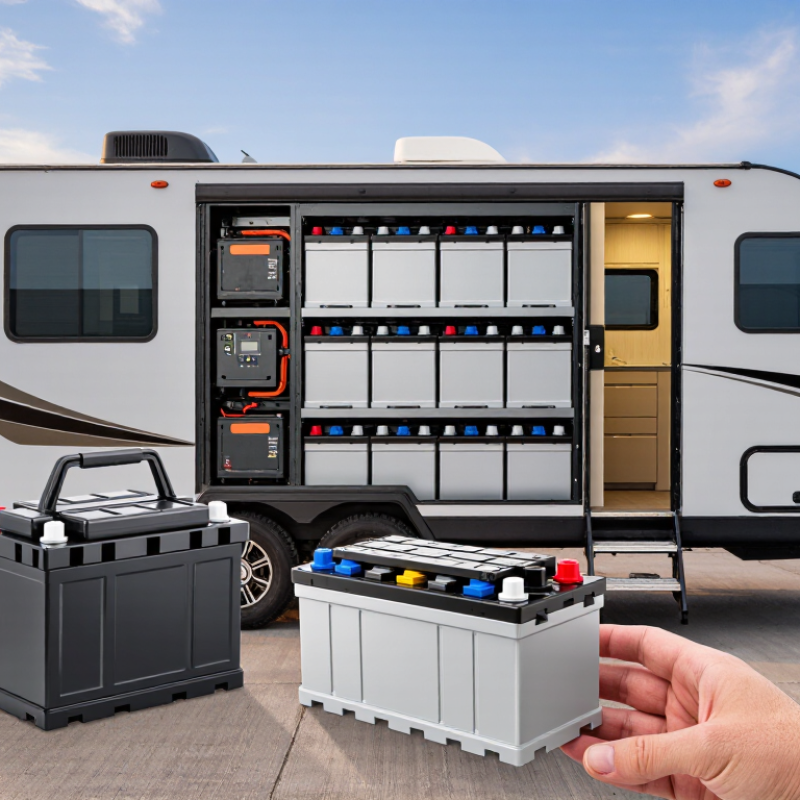
What Is a Lithium RV Battery and Is It Worth It?

What Is a Lithium RV Battery?

A lithium RV battery is a rechargeable battery that stores electricity for lights, a refrigerator, water pump, and other onboard equipment. Many RV models use lithium iron phosphate chemistry, often called LiFePO4, though “lithium” can describe several chemistries. They differ in performance and operating limits.

Inside the case, individual cells hold and release energy. A built-in battery management system monitors conditions such as voltage and temperature. It can limit charging or disconnect the battery if readings move outside its safe range. That protection matters, but it does not make every charger compatible. Check the battery’s specifications and your RV’s converter before installation.

Capacity is commonly listed in amp-hours, while voltage helps indicate the system it suits. A 100-amp-hour battery is not automatically right for every RV; daily power use and available charging sources matter. Lithium batteries can weigh less than comparable lead-acid batteries and may provide more usable capacity, but they often cost more upfront. Cold-weather charging also needs attention, since some batteries restrict charging at low temperatures. The details are easy to overlook. I would not choose one by capacity alone; check its charge limits, mounting requirements, and warranty terms.

How Does a Lithium RV Battery Work?

How Does a Lithium RV Battery Work?

Most lithium RV batteries use lithium iron phosphate cells. Inside the case, lithium ions move between electrodes during charging and discharging. That movement stores energy and releases it to power lights, a water pump, or a refrigerator. The battery supplies direct current, while an inverter can convert it to alternating current for compatible household appliances. It is a tidy process, but the battery is only one part of the system.

A built-in battery management system monitors cell voltage and temperature. It can limit charging or disconnect the battery if readings move outside safe operating ranges. This protection matters in cold weather: many lithium batteries should not be charged below their specified temperature limit. Check the battery manual and charger settings, since a lead-acid charging profile may not suit lithium chemistry. A mistake here is easy to make, especially when replacing only the battery and overlooking older equipment.

Tips: Check the battery’s temperature limits, charging specifications, and rated capacity before installation. Keep connections secure, and confirm that the charger and inverter are compatible. Cold mornings can change what charging is allowed. Lithium batteries can provide usable energy across much of their capacity, but actual runtime depends on appliance loads, temperature, and system settings.

What Types and Key Specifications Should RV Owners Know?

What Is a Lithium RV Battery and Is It Worth It?

What Types and Key Specifications Should RV Owners Know?

Most RV lithium batteries use lithium iron phosphate, or LiFePO4. It is valued for stable output and long cycle life. Some lithium packs use nickel-rich chemistries, but LiFePO4 is a common choice for deep-cycle RV use. Check the chemistry, not just the word “lithium” on a product label.

A 12.8-volt, 100-amp-hour battery stores about 1.28 kilowatt-hours before operating limits and conversion losses. That matters. Amp-hours alone can be misleading.

Compare continuous discharge current with the demands of an inverter, microwave, or coffee maker. Also check the battery management system, which can protect against overcurrent, over-discharge, and unsuitable charging conditions. Cold-weather charging limits deserve attention; a battery may discharge in freezing weather but still prohibit charging below its specified temperature.

The U.S. Department of Energy’s 2022 Grid Energy Storage Technology Cost and Performance Assessment reports roughly 85–95% round-trip efficiency for lithium-ion storage systems. That is a useful benchmark, not an RV guarantee: wiring, inverter losses, temperature, and battery settings affect real-world results. I would treat the figure cautiously.

For cycle life, compare the stated test conditions and discharge depth, rather than trusting a large cycle count without context. A cramped battery compartment makes those details feel less theoretical.

What Are the Benefits and Drawbacks of Lithium RV Batteries?

A lithium RV battery, usually lithium iron phosphate, can deliver more of its rated capacity than a lead-acid battery. That means fewer worries about dim lights or a refrigerator cycling overnight. It is also lighter, which helps when storage space and payload are limited. Charging can be quicker, especially with a suitable alternator or solar setup. Still, the charger must match the battery’s chemistry, and the battery-management system needs to be adequate. Details matter.

The drawbacks are real. Lithium batteries cost more upfront, and many models must stop charging near or below freezing unless they have low-temperature protection. A cold morning can therefore limit solar charging.

BloombergNEF reported an average lithium-ion battery-pack price of US$115 per kilowatt-hour in 2024, 20% below 2023; that global benchmark is not the retail price of an RV-ready battery. Installation, compatible charging equipment, and protection features can raise the actual bill.

I would not choose lithium only because its capacity looks larger on a label. Check usable capacity, warranty terms, cold-weather limits, and your daily power use.

A rarely used camper may not recover the higher cost quickly. A frequent off-grid traveler may value the reduced weight and usable energy more. Those trade-offs are easy to underestimate.

What Factors Determine Whether a Lithium RV Battery Is Worth It?

A lithium RV battery is usually a lithium iron phosphate pack. Whether it is worth the higher purchase price depends on how you camp, how much power you use, and how long you keep the RV. Weekend campers with hookups may gain little. Off-grid travelers running a refrigerator, lights, and a fan overnight may value its lighter weight and larger usable capacity. Check the battery’s rated capacity, cold-weather charging limits, warranty, and compatibility with your charger. A cold morning matters: some lithium batteries need protection against charging below freezing.

Cost needs a fair comparison. BloombergNEF’s 2023 Battery Price Survey reported an average lithium-ion pack price of $139 per kilowatt-hour, 14% below 2022. That is a market-wide pack benchmark, not the retail price of a finished RV battery, so it cannot predict your checkout cost. Still, it shows why prices change. Compare total costs over your expected ownership period, including any charger upgrades and installation. Then estimate how often you will use the extra capacity. If you rarely camp without hookups, the payback may be slow. For frequent dry camping, fewer weight constraints and more available energy can matter more than the initial price. The math is personal. Your actual loads may surprise you.

What Is a Lithium RV Battery—and Is It Worth It?

Typical usable capacity from a 100 Ah battery: Lead-acid batteries are commonly limited to about 50 Ah of regular use, while LiFePO₄ batteries can typically provide about 80–100 Ah, depending on the battery and operating conditions. Lithium may be worth the higher upfront cost if you need more usable energy, lower weight, or frequent cycling. Also consider battery lifespan, charging-system compatibility, cold-weather charging limits, and your expected usage.

“Guardian has been a tremendous help in providing storage and distribution solutions for AIR Global. We came to Guardian with a need, and they quickly found a solution for us at a very reasonable price. Our business is very demanding, especially during busy periods, and Guardian has been flexible and able to accommodate all requests with less than 48 hours’ notice. April, our main contact, has been extremely helpful in making sure our orders are shipped on time and that our inventory is accurate. I highly recommend using Guardian and look forward to continuing our relationship for many years to come.”

Matt Buffington
Director of Supply and Operations
Americas

“The Guardian Logistics Team is responsive and helpful on a consistent basis.  This removes a tremendous amount of stress and gives us incentive to route cargo that will touch your dock. Thanks for all that you do!!!”

Charles Reel
Branch Manager
Scan Global Logistics

“I recommend with great confidence, Guardian Logistics Solutions and owner, Brent Smith to whomever needs top shelf deliveries including Last Mile, White Glove, Residential and Commercial.

I have known GLS since its inception. Guardian is always looking for the right answer to solve the customer’s problem. I can, without hesitation, recommend Guardian Logistics to any company that is looking for the best service in their coverage area. They will team with you to create a solution that suits your needs and ensure you are satisfied with the outcome.”

Steven T. Nelson

“I highly recommend Guardian Logistics Solutions. The professionalism and communications offered by the team, along with speediness, cost saving solutions and attitude is a testament to the fact that this is one of the most important partners you can have in the freight movement business.

The company offers exemplary service, they continuously exceed our expectations and that of the importers, they help us service, Guardian Logistics Solutions is the best solid business partner you should add to your company.”

Ubaldo Sierra
Maersk Customs Brokers
General Manager

“Guardian Logistic Solutions is one of those rare companies who under-promise-and-over-deliver EVERY single time!”

James Burke
Manager, Sales Team
OLIMP Warehousing

“I want to thank the team at Guardian for the excellent service we have received.
The shipments have been professionally handled and freight arrives timely and in good order at a fair price. Communication is a very important part of the handling and Guardian does a great job of communication through the delivery.”

Cheri Zetrouer
Access Worldwide
Customs Brokers & Freight Forwarders

“I am very lucky to have found Guardian Logistics to help with our freight needs.  Our business is a bit unique in that we only receive a shipment every 2-3 months and we have to stick to a very strict time schedule in order to unload the delivery.  We found it virtually impossible to consistently coordinate with logistics companies to have shipments arrive on time and when they were expected. After multiple frustrating scenarios, our broker introduced us to Guardian Logistics who handled all of our shipments recently to perfection. Our shipments have arrived on time, when expected, with friendly and helpful drivers.  We will only be using Guardian moving forward for all of our shipping and freight needs. I couldn’t recommend them strongly enough!”

Trey Conrad
Owner
Patriot Power Source

“We have been working with the Guardian company for several years now and I can say without a doubt that their entire team cares about the service they provide. Their personal interest in their customers’ success makes them a standout in the world of final mile delivery.

I highly recommend Guardian for anyone requiring outstanding services in warehousing and final mile delivery programs.”

Frank Ianucilli
Director of Final Mile Operations
Werner Enterprises

“At WeFixFreight.com, client satisfaction is our main priority.  We are proud to partner with the top notch team at Guardian to bring our customers nothing but the best service when it comes to freight reworks, cross docking services, and final mile delivery.”

Bill Carlin
CEO
WeFixFreight.Com

“The Guardian Logistics staff has always been exceptional, and these days, with all the competition out there, it’s the service that matters. We appreciate all they do and look forward to continuing our business with GLS.”

Cathy Avolio
Ocean Import Manager
Mallory Alexander Int'l Logistics (NY), LLC
Back To Top