Top 10 Inventory Management Solutions to Streamline Your Business Operations
In today's fast-paced business environment, effective inventory management is crucial for maintaining operational efficiency and profitability. According to a recent report by Research and Markets, the global inventory management software market is projected to reach $4.3 billion by 2026, growing at a CAGR of 6.3% from 2021 to 2026. This growth is driven by increasing demand for automation and the need for businesses to manage their inventory in real-time to avoid stockouts and overstock situations. As companies strive to enhance their supply chain resilience, the adoption of innovative inventory management solutions has become a necessity.
Inventory management solutions enable organizations to optimize their inventory levels, reduce holding costs, and improve customer satisfaction by ensuring products are available when needed. A survey conducted by the American Production and Inventory Control Society (APICS) found that companies implementing advanced inventory management techniques can reduce their overall inventory costs by up to 25%. Consequently, more businesses are investing in these solutions to gain competitive advantages and streamline their operations. This article explores the top 10 inventory management solutions that can help businesses elevate their operational efficiency and adapt to the dynamic market demands.

Importance of Inventory Management in Streamlining Business Operations
Effective inventory management plays a pivotal role in streamlining business operations. When businesses have a clear understanding of their inventory levels, they can make
informed decisions that minimize costs and maximize efficiency. This reduces the risks of overstocking or stockouts,
which can disrupt operational flow and negatively impact customer satisfaction. By implementing robust
inventory management solutions, companies can optimize their supply chains, enhance
order fulfillment, and ultimately improve service delivery.
Tips for efficient inventory management include regularly reviewing stock levels and turnover rates to identify
slow-moving products. Keeping a close eye on these metrics can help businesses adjust purchasing strategies accordingly. Additionally, investing in automated
inventory management systems can provide real-time data, allowing for quicker responses
to market demands. Integration with other business systems can further enhance accuracy and streamline processes across different departments.
Another key tip is to categorize your inventory based on demand patterns. This technique, often referred to as
ABC analysis, enables businesses to prioritize their inventory management efforts on high-value items, ensuring they are adequately stocked and readily available.
By focusing on the most impactful inventory first, businesses can reduce waste and improve cash flow, reinforcing the importance of strategic
inventory management in achieving operational efficiency.
Key Features to Look for in Modern Inventory Management Solutions
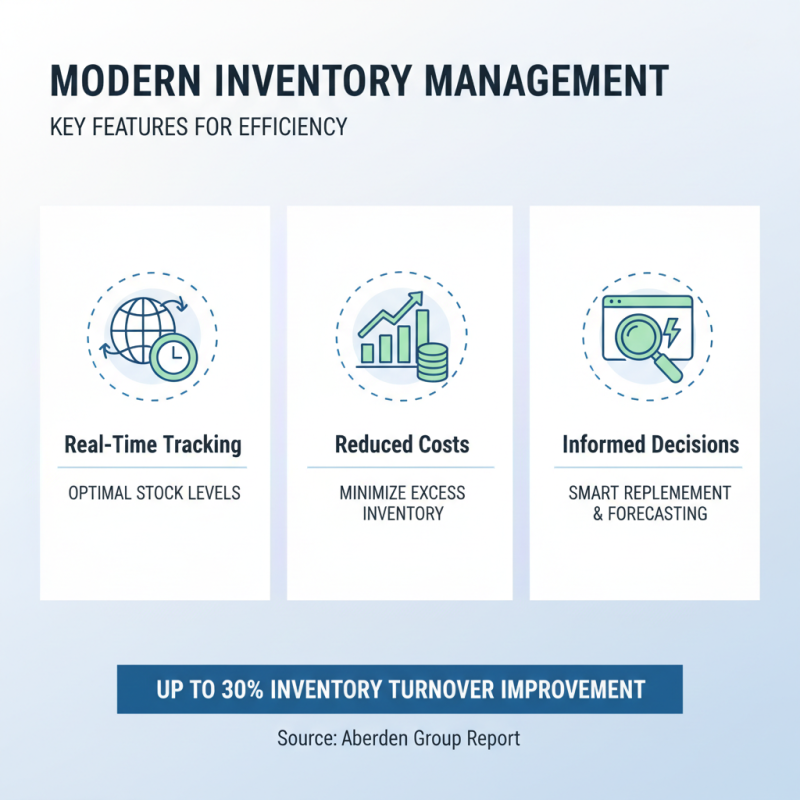
When considering modern inventory management solutions, businesses should focus on a few key features that can significantly enhance operational efficiency. A recent report from the Aberdeen Group highlights that companies utilizing advanced inventory management tools can improve inventory turnover rates by up to 30%. This metric emphasizes the importance of real-time inventory tracking, which allows businesses to maintain optimal stock levels, minimize excess inventory, and reduce carrying costs. Real-time visibility ensures that businesses can make informed decisions regarding stock replenishment and demand forecasting.
Another critical feature to consider is integration capability. A study published by the Inventory Management Institute shows that 70% of businesses that use integrated inventory systems experience fewer administrative errors and improved forecasting accuracy. Integration with other business systems, such as customer relationship management (CRM) and enterprise resource planning (ERP), can facilitate seamless data flow across departments, providing insights that enhance decision-making processes. Furthermore, automation features, such as automatic reorder alerts and inventory audits, can free up valuable employee time for strategic initiatives, ultimately leading to more streamlined operations.
Comparison of Leading Inventory Management Solutions by Market Share
When evaluating inventory management solutions, understanding their market share can provide valuable insights into their reliability and popularity among businesses. By analyzing various platforms, it becomes evident that certain solutions dominate the landscape due to their robust features and user-friendly interfaces. Companies often gravitate towards systems that not only optimize inventory tracking but also integrate seamlessly with existing business operations, enabling smoother workflows and better decision-making.
In the competitive market of inventory management, solutions vary significantly in terms of functionality and target audience. Some platforms focus on small to medium-sized enterprises, offering affordable yet effective tools tailored to their specific needs, while others cater to larger organizations requiring comprehensive systems capable of handling complex inventory chains. By comparing these solutions based on market share, businesses can identify which software might best suit their operational requirements and how these tools are positioned against one another in terms of customer satisfaction and feature sets. This analysis is crucial for organizations looking to streamline their inventory processes and enhance overall efficiency.
Top 10 Inventory Management Solutions to Streamline Your Business Operations
| Solution |
Market Share (%) |
Features |
Target Users |
Pricing (Monthly) |
| Solution A |
25% |
Real-time tracking, Reporting, Multi-channel support |
Retail, E-commerce |
$100 |
| Solution B |
20% |
Batch Tracking, Inventory Alerts, Barcode Scanning |
Manufacturing, Warehousing |
$150 |
| Solution C |
15% |
Order Management, Forecasting, Supplier Management |
Wholesale, Distribution |
$120 |
| Solution D |
10% |
Analytics, Mobile Access, Integration |
Retail, E-commerce |
$80 |
| Solution E |
8% |
Customizable Templates, Shipping Management |
Retail, Small Business |
$60 |
| Solution F |
7% |
Automated Reordering, Multi-location Control |
Manufacturing |
$110 |
| Solution G |
5% |
Supplier Integration, Invoice Management |
Wholesale, Distribution |
$90 |
| Solution H |
4% |
Inventory Auditing, Cost Control |
Retail |
$70 |
| Solution I |
3% |
Customer Management, Inventory Alerts |
Small Business, Startups |
$50 |
| Solution J |
3% |
Inventory Forecasting, Performance Metrics |
E-commerce, Retail |
$65 |
Impact of Technology on Inventory Accuracy and Efficiency
The technological landscape has dramatically transformed inventory management, enhancing both accuracy and efficiency across various industries. According to a report by the National Retail Federation, retailers that utilize advanced inventory management systems can achieve a 20% increase in inventory accuracy. This improvement is critical as inaccuracies can lead to significant financial losses and customer dissatisfaction. Technology enables real-time tracking of inventory levels, reducing the likelihood of stockouts and overstocks, which can be detrimental to business operations.
One of the key advancements in inventory management technology is the integration of automation and artificial intelligence. These tools assist businesses in forecasting demand more accurately by analyzing historical data and market trends. A study by Gartner indicates that companies employing AI-driven forecasting can see up to a 50% reduction in excess inventory costs. By leveraging such technology, businesses not only streamline their operations but also enhance their responsiveness to changing market demands.
**Tips:** To maximize the benefits of technology in your inventory management processes, ensure that your team is well-trained in using these systems. Regularly analyze inventory data to refine your approach and utilize mobile solutions to keep your team updated in real-time, enhancing decision-making on the go. Embracing these practices will help you stay competitive in an ever-evolving marketplace.
Case Studies: Successful Implementation of Inventory Management Solutions
Successful implementation of inventory management solutions can significantly enhance operational efficiency and customer satisfaction across various industries. One notable case study involved a mid-sized retail company that faced challenges with stock discrepancies and order fulfillment delays. By adopting an advanced inventory management platform, the company was able to streamline its processes.
The solution provided real-time visibility into stock levels, which helped the team make informed decisions regarding restocking and inventory turnover. As a result, they reported a 30% reduction in stockouts and an impressive 25% increase in overall sales within the first year.
Another case study highlighting the effectiveness of inventory management systems comes from a manufacturing firm struggling with production delays due to improper resource allocation. After implementing an integrated inventory management solution, the company gained better oversight of materials and components needed for production. With automated tracking and forecasting tools, they could optimize their inventory levels, ensuring that raw materials were available when required.
This adjustment led to a remarkable decrease in waste and a 40% increase in production efficiency. The successful integration not only improved their inventory management but also created a more agile production environment that responded swiftly to market demands.