Why Choose Direct Thermal Roll Labels for Global Shipping?
Global shipping turns a small label into a critical control point. Packages may move through humid ports, refrigerated trucks, dusty warehouses, and bright loading docks. Every barcode must remain readable throughout that journey. Direct Thermal Roll Labels offer a practical way to print shipping information without ink cartridges or ribbons. This reduces equipment complexity and supports faster label production during busy fulfillment periods.
Mike Fairley, a respected label-industry consultant and founder of Label Academy, has said, “A label is successful only when it stays readable throughout the supply chain.” His point reflects real operational experience. A clear tracking code can prevent sorting delays, manual searches, and unnecessary reprints. Roll formats also support compact printers, consistent feeding, and high-volume workflows. These details matter when hundreds of parcels leave a facility each hour.
Still, the choice is not flawless. Direct thermal media can react to heat, sunlight, friction, or long storage periods. That limitation deserves honest attention. Shippers should match the label material with the route, package surface, printer, and expected delivery time. Testing a sample roll in realistic conditions is wiser than trusting a specification sheet alone. A carton exposed beside a hot container door may reveal problems quickly. So can condensation on a chilled shipment. Reliable results require more than selecting the cheapest roll. They require suitable materials, controlled printing, barcode verification, and regular operator checks. Used thoughtfully, Direct Thermal Roll Labels can simplify global shipping while preserving clarity, speed, and traceability.
What Are Direct Thermal Roll Labels?
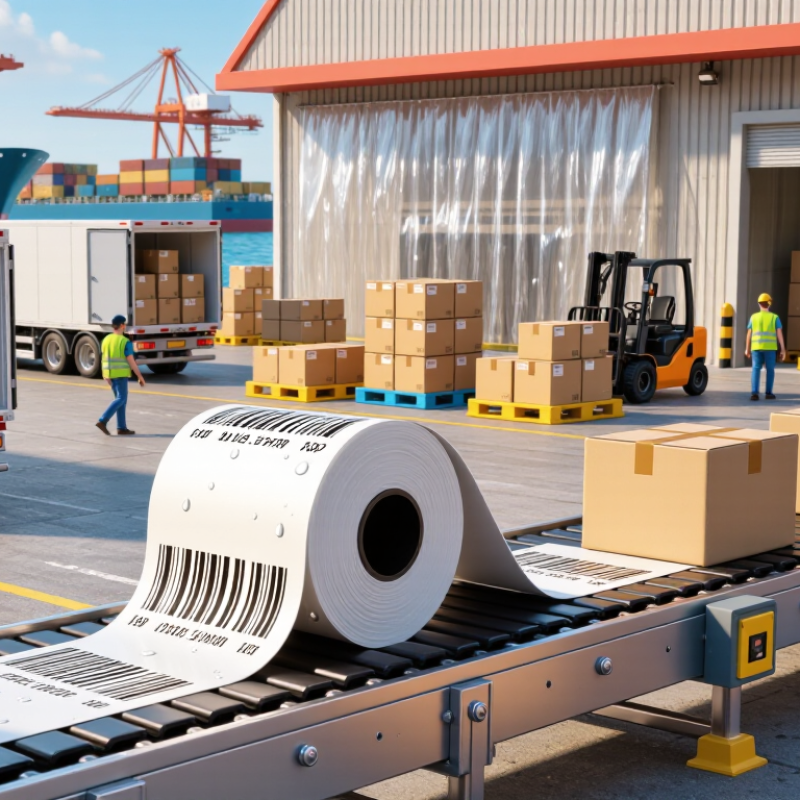
Direct thermal roll labels are adhesive labels made with a heat-sensitive coating. They create text, barcodes, and symbols through heat, not ink or toner. A thermal printhead touches the coated surface and activates selected areas. Dark marks appear quickly. Very simple.
The labels are supplied on a continuous roll, which helps packing teams print and apply them rapidly. Roll dimensions can match cartons, envelopes, pallets, or smaller parcels. In a busy warehouse, this reduces cartridge changes and keeps the packing station cleaner. Clear barcodes also support scanning at sorting points. However, label quality depends on the printer, coating, adhesive, and storage conditions.
For global shipping, direct thermal roll labels can be practical when parcels move through controlled, short-term distribution networks. They print shipping details without ink smearing, which helps during handling. Yet they are not perfect for every route. Strong sunlight, heat, moisture, and friction may gradually weaken the image. A label that looks sharp at dispatch could become difficult to scan weeks later. That risk is easy to underestimate.
Before selecting them, shipping teams should test labels on real cartons and under realistic temperatures. Check adhesion on corrugated cardboard, plastic wrapping, and recycled surfaces. Review barcode readability after rubbing, bending, and exposure to humidity. Carrier specifications and destination requirements may also differ. A lower-cost label is not always the safer choice. Sometimes, a more durable material prevents delays, relabeling, and avoidable handling work.
How Direct Thermal Printing Works for Global Shipping
Direct thermal printing creates an image when a heated printhead touches heat-sensitive coating on the label. No ink, toner, or ribbon is required. The printhead activates precise dots, forming barcodes, addresses, and routing symbols in seconds. This simple process suits busy shipping stations.
The 2023 Global Parcel Shipping Index reported 161.8 billion parcels worldwide in 2022. That volume makes fast, consistent identification essential. Direct thermal rolls reduce supply handling because operators load one material instead of managing ink supplies. Labels can emerge immediately, even during high-volume export preparation. Shorter handling time matters.
Air freight adds pressure. International Air Transport Association data showed global air-cargo demand rose 11.3% in 2024, while capacity grew 7.4%. Clear labels support repeated scanning across warehouses, airports, and delivery hubs. Still, direct thermal output is not perfect. Heat, sunlight, and prolonged storage can darken the coating or weaken contrast. A label left beside a warm loading door may become unreadable. That risk deserves testing.
A practical evaluation should examine scan performance, adhesive strength, moisture exposure, and storage duration. GS1 guidance emphasizes consistent barcode quality and reliable data structures across supply chains. Direct thermal printing helps create that consistency, but only with suitable material and calibrated equipment. It is efficient, not magic. For global shipping, controlled storage and verification remain necessary.
Key Benefits for International Logistics and Package Tracking
Why Choose Direct Thermal Roll Labels for Global Shipping?
Key Benefits for International Logistics and Package Tracking
International shipping depends on clear identification at every handoff. Direct thermal roll labels produce sharp text and barcodes without ink cartridges or ribbons. This reduces supply complexity in busy warehouses and helps operators print shipping data within seconds. A parcel moving from a loading dock to an overseas sorting center needs readable information at each scan.
Roll formats support high-volume workflows. Labels feed smoothly through compatible printers, while standardized sizes help teams reduce manual adjustments. Each label can display a tracking number, destination code, handling note, and barcode with consistent spacing. That consistency lowers scanning errors caused by cramped text or uneven printing. Small details matter.
Direct thermal printing also supports flexible package tracking. Teams can generate unique labels close to dispatch, reducing the risk of outdated shipment information. However, the material is not perfect. Heat, sunlight, friction, and moisture may affect readability over time. Logistics managers should select suitable label stock, protect parcels from harsh exposure, and test scans across real transport conditions.
A practical quality check includes scanning labels at different angles and after repeated handling. It also helps to verify barcode contrast, quiet zones, and adhesive performance on cardboard, plastic, or recycled packaging. These checks may seem minor. They often reveal problems before a shipment leaves the facility. Reliable labeling is less about appearance and more about maintaining accurate package identity across borders.
Storage, Handling, and Compliance Considerations Worldwide
Direct thermal roll labels suit global shipping because they print without ink ribbons. That reduces equipment changes at busy packing stations. Yet their storage life depends heavily on environment. Heat, sunlight, moisture, and plasticizer contact can darken or fade the image. Store rolls in sealed packaging, away from windows and radiators. Follow the converter’s temperature and humidity limits. A practical check is simple: print a sample, then rub, bend, and expose it briefly to cold and condensation.
Handling conditions also matter. The 2023 World Bank Logistics Performance Index collected 4,090 assessments across 139 economies. Its findings show that logistics reliability varies widely between markets. Labels may face long dwell times, repeated scans, and rough manual transfers. Use a strong adhesive matched to corrugated board, films, or chilled surfaces. Keep barcode quiet zones clear. Avoid placing labels across seams, curves, or damaged cartons. Direct thermal is convenient, but convenience can create complacency.
Compliance requires more than readable text. GS1 General Specifications support consistent barcode structure, placement, and verification practices. ISO/IEC 15416 provides methods for assessing linear barcode print quality. Test the actual label, printer, substrate, and scanner together. A barcode that scans in the warehouse may fail under glare or abrasion overseas. I would not approve a new roll from visual inspection alone. Retain samples, record batch details, and recheck them after storage. Requirements can differ by carrier, destination, and product category, so shipment documentation must remain current.
Why Choose Direct Thermal Roll Labels for Global Shipping?
Storage, handling, and compliance considerations across common international shipping environments
Direct thermal labels eliminate the need for ink or toner, making roll-based printing efficient for shipping workflows. The planning scores below use a five-point scale, where 1 means lower control requirements and 5 means higher attention is needed. Heat, sunlight, moisture, abrasion, and destination-specific labeling rules should be reviewed before international dispatch.